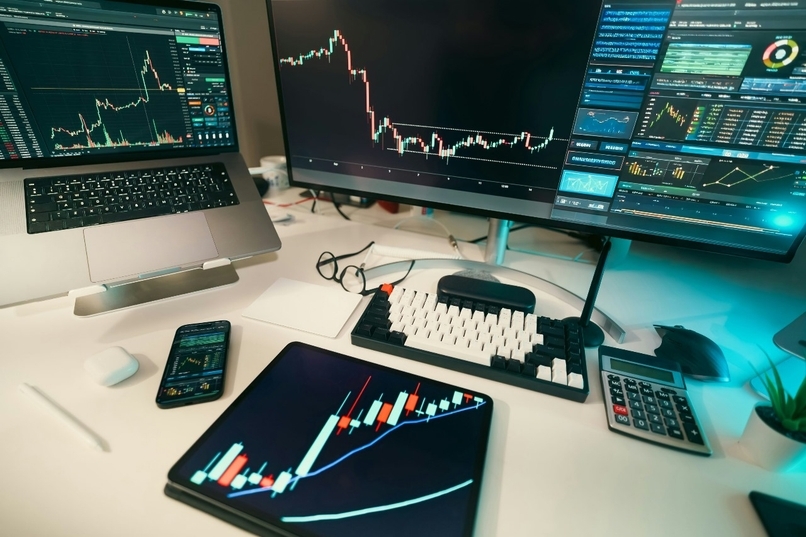
AI trading bots are transforming stocks, forex, and crypto markets. From retail platforms like 3Commas and MetaTrader to institutional players like Citadel, discover how automation drives trading. Risks apply—investors should seek professional advice.
Artificial intelligence is reshaping financial markets, and nowhere is this more evident than in the rise of AI trading bots. These automated systems, powered by algorithms and machine learning, are transforming how both retail and institutional investors approach trading. From cryptocurrencies to stocks, forex, and hedge funds, AI has become a key driver of speed, efficiency, and profitability.
AI trading bots are automated software programs that use artificial intelligence (AI), machine learning (ML), and algorithmic strategies to trade financial assets such as stocks, forex, commodities, or cryptocurrencies with little or no human intervention.
Market Data Analysisare scans real-time market data (prices, volumes, trends) and uses historical data to identify profitable trading patterns.
Predictive Modeling to Employs machine learning models (neural networks, regression, reinforcement learning) to forecast price movements and continuously improves from past trades (learns and adapts).
Trade Execution are automatically places buy/sell orders when certain conditions are met and executes trades much faster than humans.
Risk Management is sets stop-loss and take-profit levels and diversifies assets or adjusts portfolio exposure based on market volatility.
Types of AI Trading Bots
1. Arbitrage Bots – Exploit price differences across exchanges.
2. Trend-Following Bots – Identify upward/downward price trends and ride the wave.
3. Mean Reversion Bots – Assume that asset prices will revert to their average value.
4. High-Frequency Trading (HFT) Bots – Execute thousands of trades per second with small profits per trade.
5. Sentiment Analysis Bots – Scan news, social media, and online sentiment to predict market direction.
Advantages are 24/7 operation (especially useful in crypto markets), speed and precision in trade execution, removes emotional bias from trading and backtest strategies before deploying live.
Risks & Challenges
· Market volatility: Bots may fail in extreme market conditions.
· Overfitting: AI models can perform well in backtests but poorly in real-world trading.
· Security: If connected to exchanges via APIs, bots can be hacked.
· Regulation: Some markets have restrictions on automated or high-frequency trading.
· Dependence on data quality: Poor or manipulated data can lead to wrong trades.
How AI Trading Bots Work
AI trading bots operate by automating the entire trading process. They collect and analyze massive amounts of real-time data from exchanges and financial markets, including price movements, technical indicators, and even sentiment from news and social media. Advanced models such as neural networks and reinforcement learning are used to predict potential market movements.
Once a profitable setup is detected, the bot executes trades automatically through exchange APIs, often faster than any human could. Built-in risk management systems determine position sizing, stop-losses, and take-profit levels. More sophisticated bots continue learning from past results, refining their strategies over time.
The advantage is clear: bots work 24/7, eliminate human emotion, and can track dozens of assets simultaneously. Yet they are not without risks—poor data, faulty strategies, or unexpected market crashes can result in significant losses.
AI trading bots work by combining data analysis, decision-making algorithms, and automated trade execution to operate in financial markets without constant human input. Let me walk you through step by step:
Market Data Collection - The bot continuously gathers real-time data such as price movements (candlestick charts, order books, spreads), trading volume and volatility, technical indicators (RSI, MACD, Bollinger Bands) and news, social media sentiment, or even macroeconomic reports (for advanced bots). Data feeds come via exchange APIs (Binance, Coinbase, NYSE, etc.) or financial data providers (Bloomberg, Reuters).
Data Processing & Analysis - The bot applies AI and machine learning models to interpret the data. Types of analysis are technical analysis: Predicts price trends using historical price data and indicators, fundamental analysis: For stocks/forex, considers news, earnings, or economic reports, sentiment analysis: Uses NLP (natural language processing) to gauge market mood from tweets, headlines, or Reddit posts.
Prediction & Strategy Decision - AI models (neural networks, reinforcement learning, regression, etc.) try to predict price movements or identify profitable patterns.
The bot matches predictions with predefined strategies, such as trend-following (buy when the price goes up, sell when it turns), mean reversion (betting price will return to its average), arbitrage (profiting from price differences across exchanges), scalping/HFT (very short-term trades with tiny profits, repeated thousands of times).
Trade Execution. When the strategy conditions are met, the bot automatically places buy or sell orders via the broker/exchange API. Execution is instant, faster than any human could trade. Bots can handle: Limit orders (buy/sell at set prices). Stop-loss orders (sell automatically if price falls too much). Take-profit orders (lock in profit once target price is reached).
Risk & Portfolio Management. Good AI trading bots don’t just trade — they manage risk. Position sizing (how much to invest per trade). Diversification across assets. Dynamic stop-loss/take-profit adjustments based on volatility. Some advanced bots rebalance portfolios automatically (like robo-advisors).
Learning & Optimization. Advanced AI bots use machine learning to improve over time. They analyze past trades to identify mistakes or refine strategies. Some use reinforcement learning: reward profitable actions, penalize bad ones, and evolve new trading policies.
Simple Example
1. Bot scans Bitcoin prices and sees RSI < 30 (oversold).
2. AI model predicts a 70% chance BTC will rise in the next 2 hours.
3. Bot buys BTC at $60,000.
4. Sets stop-loss at $59,000 and take-profit at $62,000.
5. BTC rises → bot auto-sells at $62,000.
6. Bot records the trade result and updates its model.
Benefits. 24/7 operation (great for crypto markets). Speed & accuracy in execution. Removes human emotions (fear, greed). Can monitor hundreds of assets at once.
Risks. Bad data = bad trades (garbage in, garbage out). Overfitting: Models might perform well in backtests but fail in real markets. Market shocks: AI can’t always handle black swan events (e.g., COVID crash). Security: API keys and funds at exchanges can be hacked if not protected.
AI trading bots analyze market data, predict opportunities, execute trades, manage risk, and learn from results — all faster and more consistently than humans.
3Commas offers smart trading terminals, portfolio management, and copy trading, making it popular among both beginners and experienced traders. Launched in 2017, 3Commas is one of the most well-known crypto trading platforms. It focuses on portfolio management, smart trading terminals, and automation.
Smart Trading Terminal – Set up advanced orders like stop-loss, take-profit, and trailing stop. Grid Bots & DCA Bots – Automates accumulation strategies (buy low, sell high over time). Copy Trading – Follow professional traders’ strategies. Paper Trading – Test strategies with virtual funds before going live. Integrations – Works with 20+ major exchanges (Binance, Coinbase, KuCoin, Kraken, etc.).
Very user-friendly, suited for beginners and pros. Good balance between manual control and automation. Cloud-based (no need to keep your computer running).
Pionex stands out as an exchange with 16+ built-in bots offered for free, appealing to first-time users who want a simple start. Founded in 2019, Pionex is both a crypto exchange and trading bot platform. Unlike most competitors, its bots are built-in and free to use.
16+ Free Built-in Bots – Grid trading, DCA, leverage grid, arbitrage, rebalancing, etc. Smart Trade Terminal – Advanced stop-loss and take-profit functions. Mobile-Friendly – Strong smartphone app experience. Regulation – Licensed by U.S. FinCEN as an MSB (Money Services Business).
No additional cost for bots (you just pay trading fees). Great for beginners—easy to set up. Integrated with the exchange, so no API setup needed. Limited to Pionex exchange liquidity. Advanced traders may find strategies less customizable.
Cryptohopper
Cryptohopper provides a strategy marketplace, AI-assisted signals, and customizable automation for intermediate and advanced traders. Founded in 2017, Cryptohopper is a cloud-based crypto trading bot and marketplace for strategies.
Strategy Designer – Drag-and-drop tool to build strategies without coding. Marketplace – Buy/sell trading strategies and signals from other traders. Mirror Trading – Copy expert traders. Paper Trading & Backtesting – Test before going live. AI Features – Machine learning strategy builder.
Very customizable—ideal for traders who want more control. Strategy marketplace gives access to professional signals. Works on 15+ major exchanges. Subscription costs (tiered plans). Advanced features can be overwhelming for beginners.
Gunbot
Gunbot caters to highly technical users with lifetime licenses and extensive customization options, though it requires more expertise to operate. Launched in 2016, Gunbot is a downloadable trading bot software (not cloud-based) popular among hardcore crypto traders.
One-Time Purchase – Unlike subscriptions, Gunbot is bought with a lifetime license. Highly Customizable – Dozens of strategies (Bollinger Bands, RSI, MACD, EMA crossovers, etc.). Backtesting Add-ons – Test strategies with historical data. Community-Driven – Strong global user community with strategy sharing. Exchange Support – Works with 100+ crypto exchanges.
Lifetime license (no monthly fees). Extremely customizable—good for technical traders. Works across many exchanges. More technical setup (runs on your own computer or VPS). Steeper learning curve for beginners.
AI trading bots can be powerful tools for both retail and institutional traders, but success depends heavily on strategy design, proper risk management, and continuous optimization.
Stocks and Forex Solutions
MetaTrader 4 (MT4) & MetaTrader 5 (MT5) with AI Plugins
MetaTrader 4/5 remains the most widely used platform for retail forex and stock CFD traders. With AI plugins and Expert Advisors, users can automate strategies, though technical coding knowledge is often required.
MT4 (2005 release) – Focused primarily on forex and CFDs (Contracts for Difference). MT5 (2010 release) – Expanded to support stocks, commodities, indices, and futures. Both are developed by MetaQuotes Software and remain the world’s most widely used retail trading platforms.
Expert Advisors (EAs): Automated trading scripts (can be AI-driven) coded in MQL4 (for MT4) or MQL5 (for MT5). Custom Indicators: Technical indicators (RSI, MACD, neural network-based signals) tailored to trader needs. Machine Learning Plugins: Third-party plugins integrate AI/ML models for predictive analytics, sentiment analysis, and risk management. Examples: Zorro Trader AI, Deep Learning MT5 add-ons. Backtesting & Optimization: Strategy testing against historical data with genetic algorithms.
Free to use (brokers provide access). Massive ecosystem of community-developed bots, indicators, and AI plugins. Works with most global forex and CFD brokers.
Requires technical skills (coding in MQL). Overcrowded marketplace—quality of AI plugins varies. Latency can be an issue compared to institutional-grade platforms. Best For: Retail forex & stock CFD traders who want to automate strategies with AI-based EAs.
Trade Ideas
Trade Ideas has become a favorite among U.S. day traders. Its Holly AI scans millions of market scenarios daily and suggests high-probability stock trades in real time. Founded in 2003, Trade Ideas is a U.S.-based platform widely used by active stock traders and day traders. It’s not a broker, but a powerful AI stock scanner and trading assistant.
Holly Grail AI Engine: Proprietary AI that runs 70+ trading algorithms overnight on millions of simulations, then picks the highest-probability strategies for the next trading day. Real-Time Market Scanning: Identifies breakouts, reversals, volume spikes, unusual options flow, etc. Risk Management: Suggests entry/exit points, stop-losses, and position sizing. Backtesting Tool (OddsMaker): Tests trade ideas against historical data. Broker Integration: Connects with Interactive Brokers & E*TRADE for auto-trading.
AI-driven daily trade recommendations. Extremely popular with day traders and swing traders. No coding required; AI suggests and executes trades. Subscription cost ($118/month+). Primarily U.S. stock market–focused (limited global coverage). Not suited for long-term investors—geared toward short-term traders. Best For: Day traders & swing traders in U.S. equities who want AI-generated trading signals.
AlgoTrader
AlgoTrader represents the institutional side of AI trading. Designed for hedge funds and professional quant teams, it integrates machine learning, backtesting, and multi-asset execution at enterprise scale. Founded in 2014 in Switzerland, AlgoTrader is an institutional-grade algorithmic trading platform. It’s much more advanced than MT4/5 or Trade Ideas, designed for hedge funds, investment banks, and prop trading firms.
Multi-Asset Trading: Supports stocks, forex, futures, options, and cryptocurrencies. Quantitative Research Tools: Built-in backtesting, Monte Carlo simulations, and statistical modeling. AI/ML Integration: Uses Python, R, and TensorFlow for machine learning–based strategies. Execution Management System (EMS): High-speed order execution with smart order routing. Portfolio & Risk Management: Institution-level risk controls, stress testing, and compliance features. API & Integration: Works with FIX API, Bloomberg Terminal, and 100+ liquidity providers.
Designed for professional quant traders and institutional clients. Supports hybrid models (manual + automated + AI). Institutional-grade compliance and risk management.
Expensive licensing (enterprise-level pricing). Requires strong technical and quant knowledge. Overkill for retail traders. Best For: Hedge funds, asset managers, and professional algo traders managing large portfolios.
Institutional AI Trading Leaders
Renaissance Technologies (RenTech)
Renaissance Technologies pioneered quantitative and AI-driven trading. Its secretive Medallion Fund is considered the most successful hedge fund in history, generating over 40% annualized returns for decades.
Founded in 1982 by mathematician James Simons. Headquartered in New York, managing $50B+ AUM (Assets Under Management). Operates the legendary Medallion Fund, often called the most successful hedge fund in history.
Data-Driven Models: RenTech employs mathematicians, physicists, and cryptographers, not traditional finance people. Uses pattern recognition, ML, and predictive analytics to identify hidden signals in huge datasets. AI in Market Prediction: Algorithms process financial data, alternative data (weather, satellite imagery, shipping data), and even linguistic signals. Black Box Approach: Strategies are highly secretive; even employees know little outside their immediate work.
Medallion Fund has returned 40%+ annualized (after fees) for decades. Extremely closed — only employees and insiders can invest in Medallion. Key Strength: The best-known pioneer of AI + finance integration.
Citadel LLC
Citadel combines multi-strategy investing with AI-driven market making, accounting for a significant share of U.S. equity trading volume. Its 2022 profit of $16 billion marked a record year for any hedge fund.
Founded in 1990 by Kenneth C. Griffin. Manages over $60B AUM. One of the largest multi-strategy hedge funds and a major market maker (Citadel Securities).
Multi-Strategy AI Use: Equities, commodities, fixed income, derivatives, and FX. AI + Market Making: Citadel Securities is a top market maker on U.S. exchanges, using high-frequency trading algorithms powered by machine learning. Risk Management: AI monitors portfolios in real-time for exposure, volatility, and correlations. Alternative Data: Uses non-traditional data (credit card receipts, satellite images, online behavior) for predictions. Talent: Citadel hires heavily from computer science, AI, and quantitative PhD programs.
Generated record $16B profit in 2022, making it the most profitable hedge fund in history for a single year. Key Strength: Combines AI trading + market making with huge liquidity and speed advantage.
Two Sigma
Two Sigma blends a tech-company culture with Wall Street precision, applying deep learning, natural language processing, and crowdsourced research to multi-asset trading.
Founded in 2001 by David Siegel and John Overdeck. Based in New York, managing $60B+ AUM. Culture closer to a tech company than a traditional hedge fund.
Machine Learning Focus: Uses deep learning, NLP, reinforcement learning, and computer vision to analyze both structured (market data) and unstructured data (social media, news). Data Science–First: Employs thousands of data scientists and software engineers. Crowdsourcing Research: Runs platforms like Two Sigma Open Research and Kaggle-style competitions to source new models. Multi-Asset Trading: Stocks, futures, options, crypto, commodities. AI in Portfolio Optimization: Uses ML to rebalance and minimize drawdowns.
Solid double-digit returns in many years, though not as secretive as Renaissance. Known for applying state-of-the-art AI research directly into financial models. Key Strength: Blends Silicon Valley AI culture with Wall Street trading.
These firms prove that AI is not just an experimental tool but a dominant force shaping institutional finance.
AI trading bots are legal in the U.S., but they operate under strict oversight. The SEC regulates securities trading, the CFTC oversees futures and forex, and FINRA ensures broker compliance. Bots are widely used by individuals and institutions alike, provided they avoid market manipulation, insider trading, or operating as unlicensed brokers.
For crypto markets, exchanges like Binance.US and Coinbase allow bots via API connections, subject to KYC/AML laws. Regardless of the asset class, profits earned through AI trading remain taxable under IRS guidelines.
Retail Traders. Individual investors can legally use AI trading bots on platforms like MetaTrader, Interactive Brokers, Binance.US, Coinbase, etc. As long as you comply with exchange rules, tax reporting, and anti-fraud laws, you’re fine.
Institutions (hedge funds, brokers, market makers). Firms like Citadel, Renaissance, and Two Sigma run AI-driven strategies at institutional scale. They must register with the SEC (Securities and Exchange Commission) and CFTC (Commodity Futures Trading Commission) depending on the asset (stocks, futures, forex, crypto).
Regulations to Know
SEC (Securities and Exchange Commission). Oversees securities (stocks, ETFs, options). Automated trading must follow fair trading, anti-fraud, and disclosure rules.
CFTC (Commodity Futures Trading Commission). Regulates futures, options, and forex trading. High-frequency/algorithmic traders must avoid spoofing, layering, or market manipulation (illegal practices).
FINRA (Financial Industry Regulatory Authority). Monitors broker-dealers. If brokers offer AI trading bots to clients, they must meet compliance and suitability standards.
Crypto Exchanges (Binance.US, Coinbase, Kraken). Allow AI bots via API connections. Subject to KYC/AML laws and tax reporting to the IRS.
Legal Uses: Personal trading automation. Portfolio rebalancing with AI. AI-assisted signals and execution.
Illegal Uses: Market manipulation (spoofing orders you don’t intend to fill). Insider trading (using non-public info, even if AI analyzes it). Unregistered investment advice (selling AI bot services without SEC approval). Unlicensed broker activity (if your AI bot manages others’ funds without license).
Taxation
· Profits made by AI bots are still taxable.
· For stocks/forex → Report under capital gains tax.
· For crypto trading → IRS treats it as property, so each trade is a taxable event.
AI trading bots are legal in the U.S. for both individuals and institutions, as long as they follow SEC/CFTC rules, avoid manipulation, and properly report taxes.
The Future of AI in Finance
The rise of AI trading bots reflects a broader trend in financial markets: automation is no longer optional but essential. Retail traders gain speed and consistency, while institutions leverage AI to uncover hidden patterns and secure market advantages.
Still, the technology carries inherent risks. Poorly designed algorithms can underperform, and black swan events remain beyond AI’s predictive reach. Regulation will also continue to evolve as governments balance innovation with fairness and stability.
What is clear is that AI trading bots have already cemented their place in global markets. From retail crypto traders using Pionex bots to institutional giants like Renaissance and Citadel, artificial intelligence has become the backbone of modern trading.
Disclaimer Trading in stocks, forex, or cryptocurrencies carries significant risk. AI trading bots do not guarantee profits, and past performance is not indicative of future results. You may lose part or all of your investment. Please seek advice from a licensed financial advisor before trading.