Rising labor and rental costs in Singapore are driving businesses to expand operations into ASEAN. This article compares key expenses across Indonesia, Malaysia, the Philippines, Thailand, and Vietnam to help companies plan a more sustainable regional str
Companies Are Exploring Southeast Asia for Sustainable Growth
Singapore has long been celebrated as one of the most business-friendly environments in the world. Its world-class infrastructure, strong legal system, skilled workforce, and global connectivity have made it a preferred base for multinational corporations, startups, and SMEs alike. But in recent years, business owners—especially small and medium enterprises—have felt increasing pressure from rising operational costs. As labor, rent, and regulatory expenses continue climbing, many companies are starting to explore strategic “exit plans” or regional expansions to maintain long-term financial sustainability.
This shift does not mean businesses are abandoning Singapore entirely. Instead, many are adopting a dual-country strategy: keeping Singapore as the HQ or financial base, while shifting operational, manufacturing, talent sourcing, or support functions to more cost-efficient Southeast Asian markets.
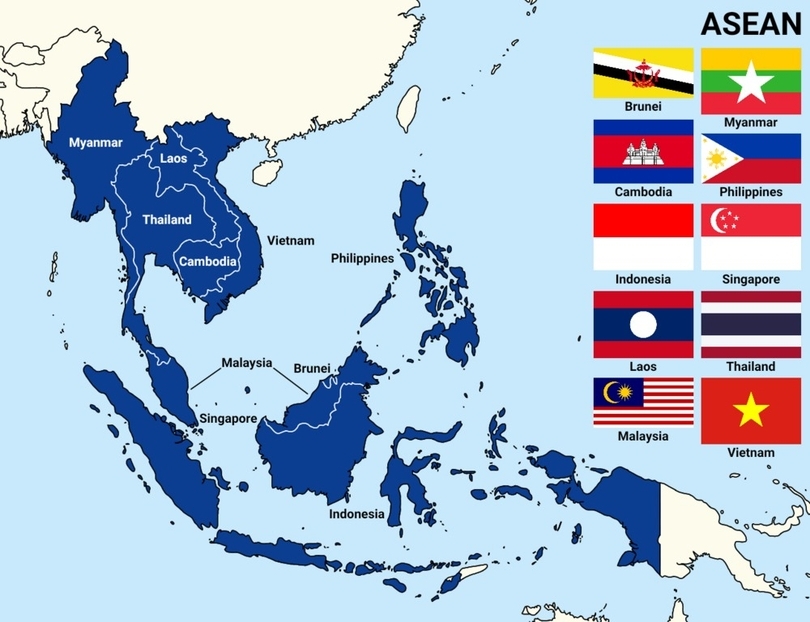
Below is an in-depth look at the forces shaping this trend and the opportunities waiting across Indonesia, Malaysia, the Philippines, Thailand, and Vietnam.
Singapore’s economy remains stable and forward-looking, but three major cost factors are accelerating business owners’ decision to diversify abroad:
Rising Labor Costs.Wage growth in Singapore has increased steadily, especially in sectors like logistics, retail, hospitality, tech support, and professional services. With foreign worker levies, quotas, and CPF obligations, the cost of hiring has become increasingly challenging for labor-intensive industries.
High Office and Commercial Rental. Office rents in prime districts have rebounded strongly, placing pressure on SMEs and startups. Even industrial rental rates—once affordable—have climbed, affecting manufacturing, warehousing, and e-commerce enterprises.
Cost of Compliance and Operations.Regulatory compliance, licensing, audit requirements, and tech infrastructure costs remain significantly higher in Singapore compared to neighboring markets.
For many business owners, these increased expenses reduce margins and limit scalability. This has pushed companies to design strategic exit or expansion plans into nearby ASEAN countries that offer lower operational costs and strong growth potential. ASEAN is one of the world’s fastest-growing regions. With a young workforce, expanding middle class, and competitive labor markets, it offers strong potential for businesses seeking sustainability.
As Singapore continues to evolve as a premium global business hub, companies—especially SMEs and mid-sized enterprises—are increasingly reassessing their long-term operational strategy. Rising labor expenses, higher commercial rentals, and tightening regulations have pushed business owners to explore Southeast Asian markets where operational costs are considerably lower and scaling becomes more financially sustainable.
This article provides an in-depth comparison of the major cost components across Singapore, Indonesia, Malaysia, the Philippines, Thailand, and Vietnam, offering business owners a clear picture of how much they can potentially save by shifting or expanding operations.
Why Cost Comparison Matters Today
Cost structures directly affect a company’s competitiveness, profit margins, and ability to grow. Singapore remains unmatched in financial stability, ease of business, and global connectivity—but affordability has become one of its biggest challenges.
Business owners now evaluate:
· Where to hire talent affordably
· Where to rent offices or warehouses at sustainable rates
· Which countries offer cost-efficient manufacturing
· Logistics and tax implications of cross-border operations
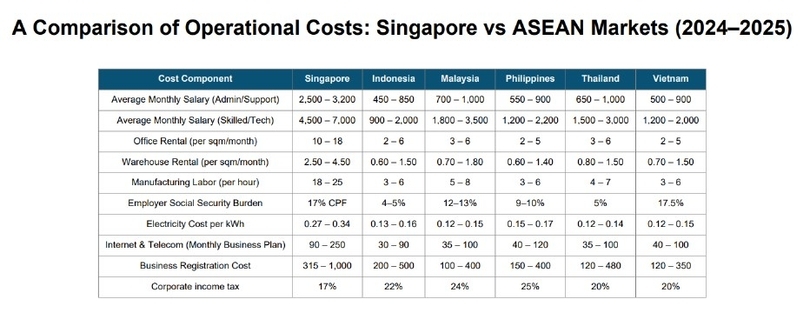
Labour Costs: ASEAN Offers 50–70% Savings - Singapore’s workforce is highly skilled, but wages—especially for mid-level and support roles—are significantly higher than in neighboring markets. For example: Hiring an admin role in Singapore costs SGD 2,500–3,200/month. The same role in Indonesia, Vietnam, or the Philippines costs SGD 450–900/month. Businesses with high headcount or support-intensive operations benefit the most from offshoring.
Office and Warehouse Rentals: Up to 5× Cheaper Outside Singapore - Real estate remains one of the biggest operational expenses in Singapore. Grade A office space in Singapore CBD: SGD 10–18 per sqm/month. Equivalent space in Kuala Lumpur, Ho Chi Minh, or Jakarta: SGD 2–6 per sqm/month. Industrial rents also show a massive gap, especially for e-commerce and manufacturing operators.
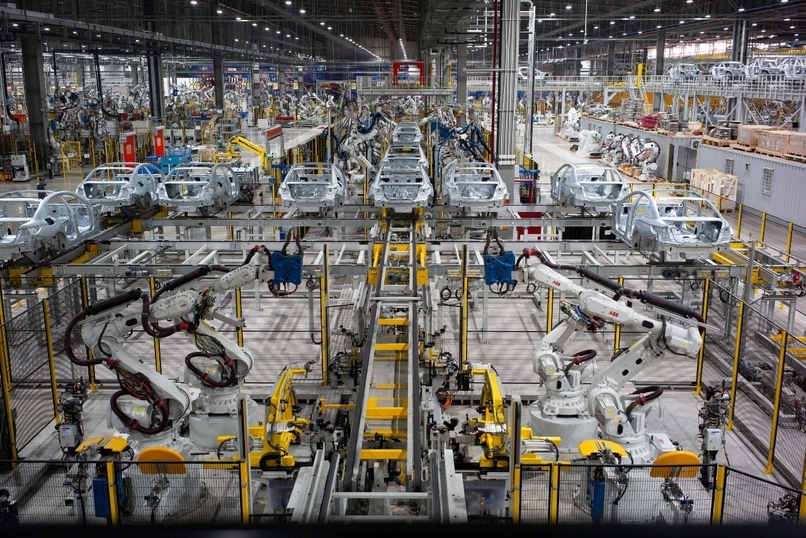
Manufacturing Costs: Thailand, Vietnam, and Indonesia Lead - Companies moving manufacturing or assembly operations find: Singapore is one of the most expensive manufacturing locations in Asia. Vietnam and Thailand offer world-class industrial zones at a fraction of the cost. Labor, utilities, and raw material access are far more favorable in ASEAN neighbors. This is why electronics, furniture, garment, and machinery manufacturers increasingly shift to Vietnam and Thailand.
Employer Burden: Singapore Has Higher Mandatory Contributions - CPF contributions (up to 17%) increase total payroll cost, while: Indonesia: 4–5%. Thailand: 5%. Malaysia: 12–13%. Vietnam is an exception at 17.5%, but total wages remain comparatively lower.
Taxation: Singapore Still Leads in Competitiveness - While operational costs in ASEAN countries are lower, Singapore remains attractive because: Corporate tax: 17%, often effectively reduced through incentives. Strong double-taxation agreements. High investor trust
Because of this, many companies keep Singapore as their HQ while shifting operational functions abroad.
Indonesia – Best for Manufacturing + Large Workforce. Low salaries. Affordable industrial land. Strong consumer market. Best for: manufacturing, logistics, BPO, hospitality, furniture, FMCG
Malaysia – Best for Singapore Proximity + Tech/Service. 30 minutes away from Singapore. High English proficiency. Great for back-office, customer service, and warehousing. Best for: SMEs, e-commerce, service companies.
Philippines – Best for Outsourcing Talent. Global leader in BPO. Ideal for voice-based and admin-intensive jobs. Best for: customer support, accounting, virtual assistant, design.
Thailand – Best for Hospitality + Light Manufacturing. Strong tourism. Competitive industrial ecosystem. Best for: F&B, wellness, electronics assembly, packaging.
Vietnam – Best for Manufacturing Scale + Tech Talent. Manufacturing giant of Southeast Asia. Fast-growing tech sector. Best for: electronics, apparel, furniture, software development.
The data clearly shows that operating entirely in Singapore is becoming costly for many businesses. However, leaving Singapore entirely is not ideal either because of: its global reputation. Strong financial and regulatory environment. Reliable infrastructure.
This has given rise to the dual-country operational model, where companies: Maintain HQ in Singapore (finance, management, global partners). Shift operations to ASEAN markets (support, manufacturing, logistics, talent). Lower total cost by 40–70% while scaling faster. This hybrid structure is quickly becoming the new standard for sustainable business growth in Southeast Asia.
Indonesia – Expansive Market and Competitive Labor Cost
Indonesia is Southeast Asia’s largest economy, offering: Large workforce with more flexible hiring costs compared to Singapore. Growing digital economy, supported by e-commerce, fintech, and manufacturing. Key hubs like Jakarta, Batam, Surabaya, and Bali for different industries. For Singapore businesses, Batam and Bintan have become especially attractive due to proximity—just an hour’s ferry ride—making them ideal for manufacturing, warehousing, and back-office operations. Industries that benefit most: furniture manufacturing, FMCG, digital marketing support, logistics, hospitality, and consumer goods.
Malaysia – Operational Efficiency and Proximity Advantage
Malaysia offers one of the best “spillover benefits” for Singapore companies: Lower cost of living and business operations. Strong English proficiency. Proximity to Singapore (Johor Bahru is 30 minutes away). More affordable warehouse, office, and factory space. The Malaysian government also provides attractive incentives for startups and digital businesses in Kuala Lumpur, Penang, and Johor. Industries that benefit most: tech support, customer service, SMEs in retail/e-commerce, manufacturing, F&B, and back-office operations.
Philippines – Skilled Workforce and Cost-Effective Outsourcing
The Philippines has grown into a global leader for service outsourcing with: High English proficiency (top 3 in Asia). Strong BPO ecosystem for customer service, finance, design, and tech. Competitive wages for skilled roles. Many Singapore companies move customer support, accounting, digital marketing, and admin functions to Manila or Cebu to reduce manpower expenses while maintaining service quality. Industries that benefit most: customer support, virtual assistance, design, fintech, and corporate services.
Thailand continues to attract companies with: Strong manufacturing infrastructure. Affordable workforce. Good logistics and supply-chain ecosystem. Appealing lifestyle for expatriates and staff relocation. Bangkok is ideal for service-related businesses, while Chiang Mai, Phuket, and Pattaya offer low-cost alternatives for creative industries and remote teams. Industries that benefit most: manufacturing, food production, creative agencies, hospitality, wellness, and lifestyle brands.
Vietnam – Rising Manufacturing Hub and Fast-Growing Economy
Vietnam is one of the most talked-about markets for Singapore’s expansion, thanks to: Young and skilled workforce. Competitive labor and office rental cost. Increasing governmental support for foreign investors. Strong manufacturing sector, especially electronics and textiles. Cities like Ho Chi Minh City, Hanoi, and Danang offer dynamic business environments suitable for tech, engineering, and export businesses. Industries that benefit most: manufacturing, electronics, software development, export trading, and logistics.
The Sustainable Business Strategy – Regionalizing Your Operations
Modern businesses no longer operate from a single location, and for Singapore-based companies, the most resilient long-term strategy is to maintain Singapore as the corporate headquarters while decentralizing operations across the region. Keeping HQ in Singapore ensures strong foundations in finance, branding, legal structure, global partnerships, and investor confidence — advantages that are difficult to replicate elsewhere. At the same time, shifting operational or support functions to more cost-efficient countries allows companies to reduce expenses while boosting productivity and scalability.
Across ASEAN, each country offers strategic strengths that complement Singapore’s role as a high-value command center. Indonesia and Vietnam provide manufacturing capacity and labor affordability, Malaysia offers mature infrastructure and bilingual talent, while the Philippines excels in customer service and back-office support. By distributing operations intelligently across these regional hubs, businesses can optimize performance while maintaining cost control.
To fully unlock this model, companies must also invest in building a regional talent strategy. This means combining Singapore’s leadership expertise with operational teams in neighboring countries, creating an agile, cross-border workforce that can react quickly to market opportunities. The result is a stronger, more scalable business structure — one that leverages Singapore’s global credibility while tapping into ASEAN’s diverse advantages.
Hiring in Indonesia, Malaysia, the Philippines, Thailand, or Vietnam enables companies to stay competitive while accessing skill sets that complement Singapore’s workforce.
Singapore remains one of the world’s strongest business centers, but the rising cost environment is encouraging a more sustainable, region-focused approach. By strategically expanding into major Southeast Asian markets, business owners can reduce operational costs, diversify risks, and create a scalable structure that supports long-term growth.
With the right planning, shifting or expanding operations into ASEAN countries is not an exit from Singapore—but a smart evolution toward regional sustainability.