Bali is emerging as a potential international financial hub, attracting foreign investors, family offices, wealth managers and global capital.
Bali is emerging as a potential international financial hub, attracting foreign investors, family offices, wealth managers and global capital.
BALI, INDONESIA — Bali has long been associated with beaches, luxury resorts, wellness retreats and a thriving international tourism economy. Now, the island is being considered for something far more ambitious: a role in Indonesia’s emerging international financial-center strategy.
The Indonesian government is developing the Indonesia International Financial Center (IIFC) with both Jakarta and Bali being considered as locations. The government has accelerated the initiative, while evaluating strategic areas in Bali, including Kura Kura Bali and Sanur. The Indonesia International Financial Center (IIFC) is a broader national strategic initiative intended to make Indonesia a more competitive regional and international financial hub.
In July 2026, President Prabowo instructed the government to accelerate the establishment of the Indonesia International Financial Center. The government said the initiative is intended to strengthen Indonesia's competitiveness as an investment destination and international financial-services center. The legal framework is being advanced following approval processes involving Parliament.
Indonesia International Financial Center (PFII) is being prepared for both Jakarta and Bali. Coordinating Minister Airlangga Hartarto confirmed that government-owned land/assets are being prepared in both locations, although the exact Bali site has not yet been publicly finalized. More importantly, in May the government was already actively evaluating KEK Kura Kura Bali and KEK Sanur as potential strategic areas for the financial-center initiative.
Bali is different from Jakarta
I would see the government's strategy potentially developing into something like:
Jakarta = Indonesia's domestic financial capital
Bali = Indonesia's international financial and wealth-management gateway
That's not yet an official division of roles, but it makes strategic sense. Jakarta already has: Banks. Indonesia Stock Exchange. OJK. Corporate headquarters. Investment institutions. Domestic capital markets. Government financial institutions. Bali has something Jakarta cannot easily replicate: international lifestyle + tourism + high-net-worth individuals + global connectivity + resort infrastructure. That makes Bali particularly attractive for family offices and international wealth.
Bali's New Financial Ambition
Indonesia already has a substantial domestic financial ecosystem centered around Jakarta. The capital is home to major banks, financial institutions, the Indonesia Stock Exchange, regulators and corporate headquarters. Bali offers something completely different. The island combines an established international tourism economy with luxury hospitality, residential development, healthcare, wellness, international communities and strong recognition among wealthy travelers. That combination could allow Bali to develop a financial-center model based not only on banking and capital markets, but also on wealth, lifestyle and investment.
The Indonesian government has been examining Bali as part of the broader international financial-center initiative. In particular, KEK Kura Kura Bali and KEK Sanur have emerged as strategic areas under consideration. The objective is not simply to construct another collection of office buildings. The larger ambition is to create an ecosystem capable of attracting international financial institutions, investors, wealth managers and high-net-worth individuals. For foreign investors, that distinction matters.
The family-office angle is particularly interesting
Family Offices Could Be Bali's Biggest Opportunity. One of the most interesting elements of Bali's financial-center strategy is the potential development of a family-office ecosystem. Indonesia has been trying to position itself to attract wealthy Indonesian and international families, particularly through a stronger ecosystem for wealth management and investment. A successful international financial center could eventually create an environment where a wealthy family could establish:
Family Office à Investment Management à Private Equity / Venture Capital à Real Estate à Public Markets à Global Investments
Family offices manage the wealth of high-net-worth families, overseeing investments, asset allocation, succession planning and often philanthropic activities. Singapore has become one of Asia's leading destinations for family offices because of its sophisticated financial infrastructure, regulatory reputation and concentration of professional services.
Indonesia wants to capture more of this wealth domestically. In 2026, government officials publicly discussed developing a family-office ecosystem around the proposed Bali financial center. The ambition reflects a broader attempt to attract international capital and encourage wealthy investors to establish a presence in Indonesia.
The potential market is enormous. Indonesia has created substantial private wealth through commodities, manufacturing, property, technology and other industries. At the same time, wealthy families from across Asia are increasingly looking for jurisdictions where they can manage global investments while maintaining access to attractive lifestyle destinations.
Bali naturally fits that second requirement. A future family office in Bali could potentially combine international portfolio management with investments in Indonesian real estate, hospitality, infrastructure, private companies, technology and other alternative assets. That creates a proposition that is fundamentally different from a conventional financial district.
Indonesia has a major challenge
The competition is extremely strong. Indonesia isn't competing against an empty market. It is competing with established financial centers such as: Singapore. Hong Kong. Dubai. Abu Dhabi. Switzerland. London. Singapore is particularly important because it has already developed a sophisticated ecosystem for family offices, private banking, asset management, funds, professional services and cross-border investment. Therefore, simply declaring an Indonesian financial center isn't enough. Indonesia would need to offer investors:
Regulatory certainty - Investors need confidence that regulations won't change unpredictably. Tax competitiveness - The overall tax structure needs to be competitive with alternative jurisdictions. Capital mobility - International investors need efficient mechanisms for bringing capital in and taking legitimate investment proceeds out. Strong financial regulation - OJK and Bank Indonesia need to provide internationally credible supervision. Professional ecosystem - Law firms, accountants, auditors, fund administrators, investment managers and corporate advisers are critical. International connectivity - The center needs strong links to global capital markets. Political and institutional stability. High-quality infrastructure. Talent. Without these, an impressive financial district can simply become another collection of Grade-A office towers.
Bali Versus Singapore
The obvious comparison is Singapore. Singapore already possesses one of the most sophisticated financial ecosystems in Asia. It has international banks, private banks, asset managers, law firms, accounting firms, fund administrators and a mature regulatory system. Bali cannot realistically compete with Singapore simply by attempting to replicate its financial infrastructure.
Instead, Bali's potential advantage is lifestyle. Singapore's proposition is largely finance first. Bali could potentially offer: Finance + wealth + lifestyle + investment + hospitality. For a wealthy entrepreneur or family, the proposition could eventually look very different.
Instead of maintaining a purely financial presence in a dense metropolitan center, a family could potentially establish a wealth-management structure in Bali while having access to luxury residences, resorts, wellness facilities, healthcare, international education and Indonesia's broader investment market. That doesn't mean Bali will replace Singapore. It doesn't need to. Bali could instead develop a specialized niche within Southeast Asia's financial ecosystem.
The Dubai Comparison
Another useful comparison is Dubai. Dubai successfully transformed itself into an international business and financial center by combining tax incentives, international connectivity, real estate, luxury lifestyle and business-friendly regulations. Indonesia's policymakers have looked at international financial centers such as Dubai when considering how to build the country's own model. Bali has some of the same ingredients. It has global tourism recognition, luxury hospitality, an international population, substantial property development and a lifestyle proposition that is difficult to replicate elsewhere in Indonesia. But there is one major difference. Dubai has spent decades building a highly specialized regulatory and financial infrastructure for international businesses. Bali is only beginning that process.
The strategic locations:
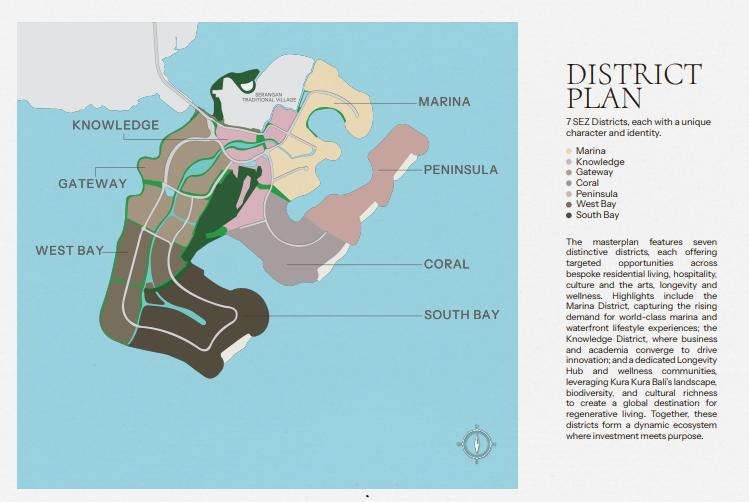
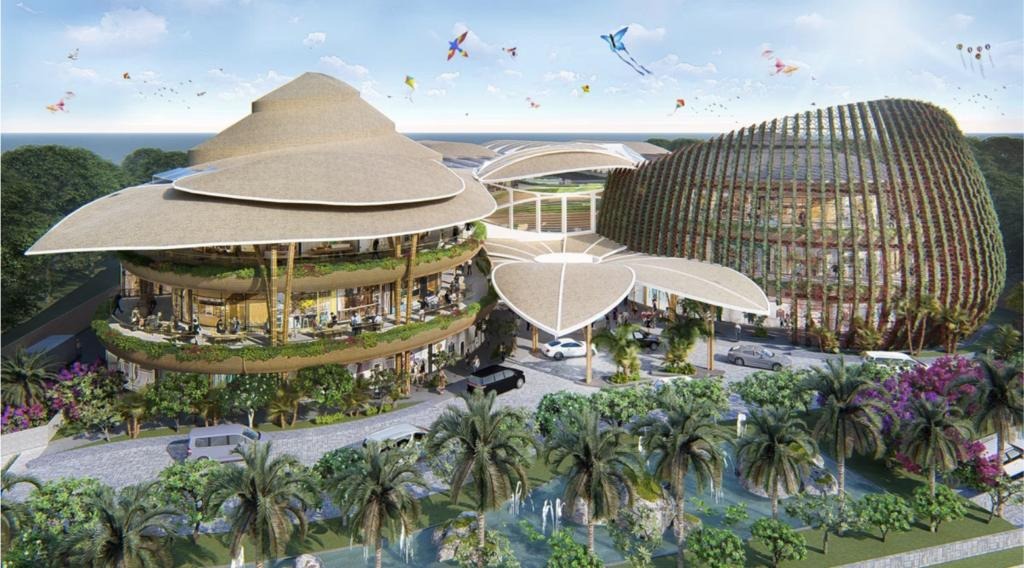
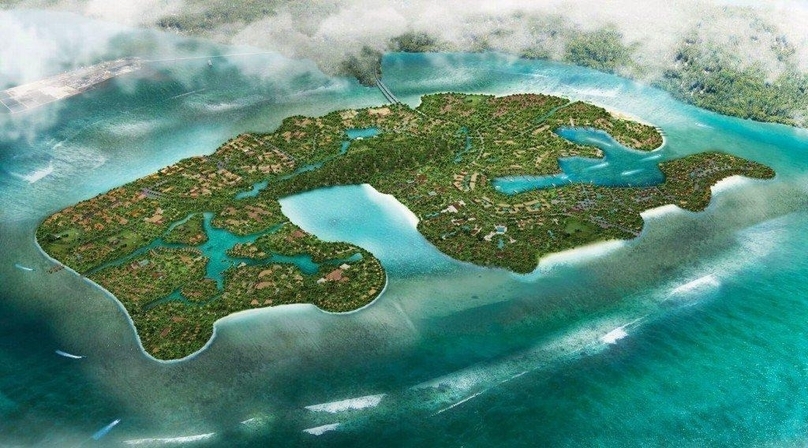
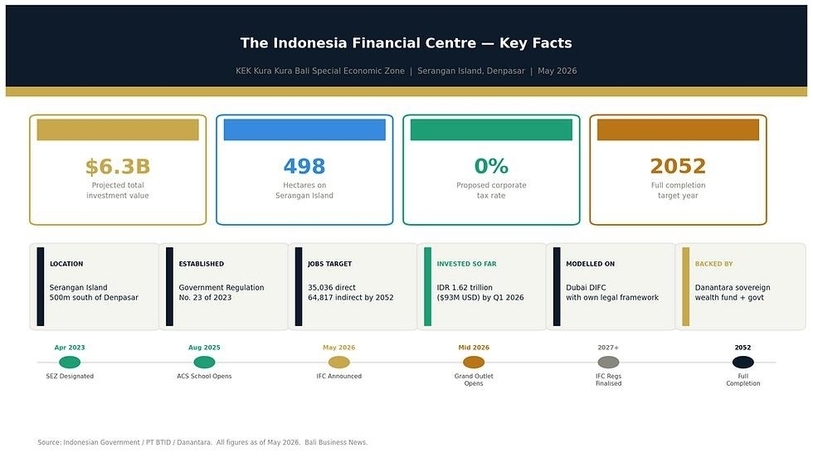
Kura Kura Bali - Probably the most interesting location from the financial-center perspective because the government has specifically been evaluating it as part of the strategic development. Among the locations being watched, Kura Kura Bali could become particularly important. Located on Serangan Island, the development has been planned as a large-scale integrated economic and lifestyle destination. Its potential role in the financial-center strategy makes it worth watching because the concept could eventually bring together several sectors: Financial services. Family offices. Luxury residences. Hospitality. Healthcare. Technology. Investment. That combination could create an entirely different type of business district. Rather than separating financial services from lifestyle and residential development, Bali could attempt to integrate them.
The government has been looking closely at KEK Kura Kura Bali, on Serangan Island. The attraction isn't simply financial services. The concept is closer to: Finance + Wealth + Luxury Living + Investment + Tourism + Healthcare + Business. That is potentially very powerful. A wealthy international investor could theoretically:
Live in Bali → operate a family office → invest in Indonesian companies → meet fund managers → participate in private equity → invest in Indonesian property → access healthcare and hospitality → travel around Southeast Asia. For investors in real estate, this is particularly significant. A successful financial center could attract executives, entrepreneurs, investment professionals and wealthy families. Those individuals would create demand for premium housing, serviced residences, branded residences and luxury villas. The financial-center strategy could therefore have consequences far beyond banking.
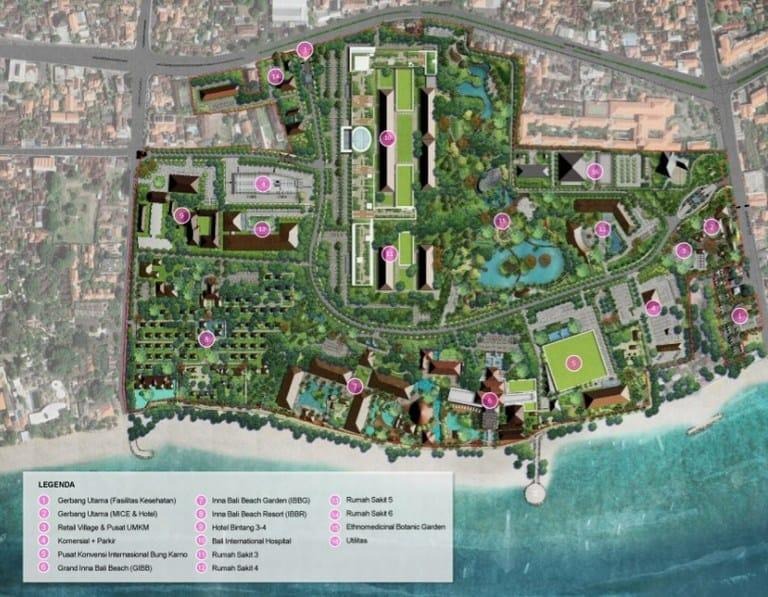
Sanur - Sanur already has a government-backed Special Economic Zone and major healthcare/tourism development, making it potentially complementary to the financial-center concept. Sanur is another important location because it already has a significant government-backed economic development strategy. The area has been positioned around healthcare, tourism and international-standard facilities, creating potential synergies with a broader financial and investment ecosystem.
Nusa Dua / southern Bali - This is interesting because of its existing concentration of: Five-star hotels. International conferences. Foreign investors. Luxury residences. Tourism infrastructure. International visitors.
Healthcare is particularly relevant to wealthy international residents. A financial center designed to attract family offices and high-net-worth individuals needs more than banks and offices. It needs the infrastructure that makes wealthy international families comfortable establishing a long-term presence. High-quality healthcare, education, hospitality and residential infrastructure can therefore become part of the financial-center proposition. This is one of Bali's potential strengths. Despite the excitement surrounding the concept, sophisticated investors are unlikely to commit capital simply because the government announces a new financial center.
The government has already moved toward creating a legal framework for international financial centers. Parliament passed legislation in July 2026, with the framework designed to provide incentives and regulatory arrangements intended to attract international financial businesses.
One of the most significant elements of Indonesia's international financial-center framework is the use of incentives to attract international businesses. The legislation includes substantial tax incentives for qualifying investors, including a reported corporate income-tax holiday of up to 50 years for eligible businesses. Such incentives could make Indonesia considerably more competitive.
However, international investors tend to look beyond headline tax rates. A tax advantage is valuable only when combined with regulatory certainty, efficient administration, reliable infrastructure and confidence that the rules will remain stable. For a financial institution managing billions of dollars, predictability can be more important than a temporary tax benefit.
The Biggest Risk Is Execution
Bali's greatest challenge is not a lack of attractiveness. It is execution. Building office towers is relatively straightforward. Building a financial ecosystem is much harder. A successful international financial center requires bankers, fund managers, lawyers, accountants, tax specialists, compliance professionals, investment advisers, private-equity specialists, technology companies and regulators.
It also requires international credibility. Singapore has spent decades building that credibility. Bali will need to build it from an earlier starting point. That means foreign investors will probably watch the first wave of institutions very carefully. If respected international banks, asset managers, family offices and professional-services firms begin establishing operations in Bali, confidence could increase quickly. If major institutions remain reluctant to commit, the development could take considerably longer.
The most realistic vision is probably not "Bali becomes the next Singapore." A more credible proposition is that Bali could become a specialized wealth and lifestyle hub within Southeast Asia's broader financial network. Singapore could continue to dominate institutional finance, private banking and regional headquarters. Jakarta could remain Indonesia's primary domestic financial center. Bali could develop a niche around: Family offices. Private wealth. Alternative investments. International entrepreneurs. Luxury real estate. Hospitality investment. Healthcare investment. Lifestyle-driven wealth management. That would give each location a different role.
What It Means for Real Estate
The potential impact on Bali's property market deserves particular attention. If international financial businesses and family offices establish a presence on the island, demand could emerge for a new category of property buyers.
These would not necessarily be traditional holiday-home purchasers. They could include: Family-office principals. International executives. Investment professionals. Entrepreneurs. Wealthy retirees. Global investors. Corporate representatives. Their requirements could be very different from ordinary tourism-driven property demand. They may want secure residences, branded residences, serviced apartments, private villas, healthcare access and proximity to business facilities. This could strengthen the long-term case for premium residential developments in strategically connected areas of southern Bali.
However, investors should be careful not to assume that every Bali property will benefit equally. The strongest opportunities would likely be concentrated around areas that become connected to the financial and infrastructure ecosystem.
Bali's New Investment Proposition
For foreign investors, Bali's financial-center story is therefore both attractive and speculative. The opportunity is clear. Indonesia is one of the world's largest emerging economies. Bali is already one of Asia's best-known international lifestyle destinations. The government is actively seeking foreign capital, while the new financial-center framework provides a foundation for attracting international financial businesses. But the risks are equally clear. The financial ecosystem is still developing. Regulations need to be implemented. International institutions need to be attracted. Investor confidence needs to be earned. The next several years will determine whether Bali's financial-center ambition becomes a functioning international ecosystem or remains primarily a government development concept.
The Indonesian government itself is clearly targeting international capital. Parliament passed the international financial-center law in July 2026, with incentives intended to attract banks, wealth managers, leasing companies and other international financial businesses. The government estimates potential investment inflows of up to Rp500 trillion (roughly US$28 billion).
Foreign investors like the idea of Bali. This is probably Bali's strongest advantage. A financial center doesn't necessarily have to compete purely on banking infrastructure anymore. For wealthy investors, entrepreneurs and family offices, quality of life is becoming part of the investment proposition. Bali offers: International tourism infrastructure. Luxury hospitality. Villas and resorts. Wellness. International schools. Healthcare development. International restaurants. Large expatriate communities. Direct international air connections. Strong Asian connectivity. That makes Bali fundamentally different from Jakarta. The government is specifically examining Kura Kura Bali and Sanur as strategic areas for this development, with the economic ministry emphasizing investment in high-quality tourism and internationally standardized healthcare.
Family offices are probably the biggest opportunity. This is where I think foreign investors will pay the most attention. Indonesia has been openly discussing positioning Bali as a location for family offices. In May 2026, Luhut Binsar Pandjaitan said President Prabowo had approved the development of a family-office ecosystem around the proposed Bali International Financial Center. And in June, Luhut said the government hoped the initiative could attract hundreds of billions of dollars of potential capital, while emphasizing the need to maintain positive sentiment among international investors.
The real competition is Singapore. A wealthy Indonesian, Singaporean, Chinese, Korean or other Asian family already has an obvious choice: Singapore. Singapore already has: Global banks. Private banks. Fund managers. Family offices. International law firms. Accountants. Tax advisers. Asset managers. Strong regulatory credibility. Deep capital markets. Established international reputation. So Bali cannot simply say: "We will become another Singapore." That would be very difficult. Instead, Bali needs a different proposition. Bali. “Financial services + lifestyle + investment opportunities + wealth preservation” That is a much more realistic positioning.
Tax incentives could change the conversation. This is potentially very significant. The international financial-center legislation passed in July reportedly includes a 50-year corporate income-tax holiday for qualifying investors, along with provisions allowing foreign currencies to be used inside the financial centers and other tax incentives. Those incentives are designed partly with places such as Dubai in mind. For a multinational financial institution, this could make the proposition much more interesting.
Foreign investors will be concerned about regulation. This is probably Bali's biggest weakness today. The financial-center concept is advancing rapidly, but the detailed operating framework is still developing. Foreign financial institutions will want clarity on: Licensing. Capital requirements. Foreign ownership. Tax treatment. Repatriation of profits. Foreign-currency transactions. Investment management. Fund structures. Family-office structures. Data protection. AML/KYC. Dispute resolution. Bankruptcy. Arbitration. Regulatory supervision. The July legislation is designed to address some of these issues, including a dedicated supervisory structure and special dispute-resolution mechanisms. But the implementation details will matter more to investors than the announcement itself.
Kura Kura Bali is the place I would watch. The government has specifically been accelerating development of KEK Kura Kura Bali as a potential financial-sector SEZ. This is important because it creates the possibility of combining: Financial Center. Family Office. Luxury Residential. Hospitality. Healthcare. Education. Technology. Investment. That combination is considerably more interesting than simply building another CBD.
And this creates an interesting real-estate opportunity. This is where I think Bali's financial-center story becomes particularly interesting for investors. If successful, the chain could look like: International Financial Center à Foreign banks & wealth managers à Family offices à High-net-worth individuals à International executives & entrepreneurs à Demand for premium residences à Luxury villas / branded residences / serviced residences à Hospitality + healthcare + lifestyle. That means the financial center could potentially create secondary demand for premium real estate. This is one reason I would watch areas around Serangan/Kura Kura, Sanur and the established southern Bali luxury corridor very carefully.
For decades, Bali's economic proposition was simple: Come for tourism. The next chapter could be considerably more ambitious: Come to live, invest, manage wealth and build businesses. That is a fundamentally different proposition. If Indonesia can combine credible financial regulation with tax competitiveness, international professional services, quality infrastructure and Bali's extraordinary lifestyle appeal, the island could develop a financial niche unlike anything else in Southeast Asia. It will not happen overnight. And it will not necessarily challenge Singapore head-on.
But for foreign investors looking five or ten years ahead, Bali's emergence as a potential international financial and wealth hub is becoming a story worth watching. The most important question is no longer whether Indonesia wants Bali to play a role in international finance. The question is whether Indonesia can build an ecosystem sophisticated enough to make global capital stay.