The ROHM Japan Way to Building a Business That Lasts
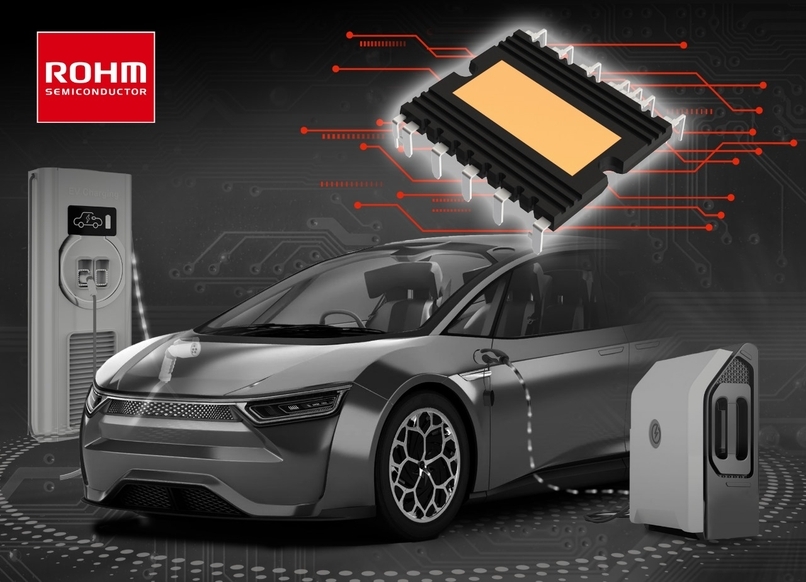
ROHM supplies advanced SiC MOSFET chips used in ZEEKR’s EV models (001, 009, X) under Geely Group. These chips enhance power efficiency, reduce heat, and extend driving range—showcasing ROHM’s innovation leadership in next-generation electric vehicle tech
In the world of technology and precision engineering, few companies reflect Japan’s quiet excellence like ROHM Co., Ltd. Founded in Kyoto in 1958 by Ken Sato, ROHM began as a humble resistor manufacturer. Today, it stands as a global leader in semiconductors, integrated circuits, and power devices, supplying giants in the automotive, industrial, and energy sectors. But beyond its products, ROHM’s story carries powerful lessons for entrepreneurs and businesses — lessons about focus, innovation, and integrity that remain timeless.
ROHM Co., Ltd. (ローム株式会社, ROHM Kabushiki-gaisha) is a Japanese semiconductor and electronic component manufacturer headquartered in Kyoto, Japan. Founded in 1958 by Ken Sato, ROHM started as a small resistor manufacturer and has since evolved into one of Japan’s leading global semiconductor companies.
Founder: Ken Sato. CEO (as of 2025): Isao Matsumoto. Employees: ~23,000 (global). Stock Exchange: Tokyo Stock Exchange (Ticker: 6963)
ROHM designs and manufactures semiconductors, integrated circuits (ICs), and discrete components. Its products are widely used in automotive, industrial, consumer electronics, and communication devices. Main Product Categories:
Semiconductors. Power semiconductors (SiC, IGBT, MOSFET). Analog ICs (power management, motor drivers, sensors). Digital ICs (microcontrollers, memory, logic)
Electronic Components. Resistors (where ROHM began). LEDs and laser diodes. Transistors and diodes
Modules & Power Solutions. Power modules for EVs and hybrid cars. SiC (silicon carbide) power devices for high-efficiency energy management
ROHM is a major supplier to automotive and industrial electronics manufacturers, with a strong presence in: Electric vehicles (EVs) and hybrids. Factory automation and robotics. Renewable energy systems. Consumer electronics (smartphones, audio equipment).
Supply to Vitesco Technologies (Germany) for EV powertrains ROHM signed a long-term supply deal with Vitesco, valued at more than US$1 billion for the period 2024-2030, for SiC power semiconductors used in EV powertrains and high-voltage conversion modules. The agreement stems from a development partnership starting in 2020. This shows ROHM is targeting major Tier-1/2 suppliers in the EV segment, not just direct automakers.Also signals that ROHM’s SiC devices are positioned for high-voltage / high-efficiency applications — e.g., 800 V architectures.
Adoption by ZEEKR (under Geely Holding Group) for EV models ROHM announced that its 4th-generation SiC MOSFET bare chips (and power modules built around them) have been adopted in traction inverters of three ZEEKR EV models (X, 009 and 001) since 2023. These modules are produced via a joint-venture “HAIMOSIC (Shanghai) Co., Ltd.” between ROHM and Zhenghai Group. Demonstrates ROHM’s capability to supply high-performance components for battery-electric vehicles (BEVs) in the premium/volume China EV market. Also indicates ROHM is already in mass-production supply (or has begun) for mainstream EVs, not just niche or R&D. Car Models: ZEEKR X: A compact SUV from ZEEKR which features ROHM SiC power modules in its traction inverter. ZEEKR 009: A minivan model from ZEEKR, also using ROHM’s SiC MOSFET chips for improved range and efficiency. ZEEKR 001: The flagship dual-motor performance model by ZEEKR that incorporates ROHM’s modules in its drivetrain.
Joint development with Mazda Motor Corporation / Imasen Electric Industrial Co., Ltd. for e-Axle inverters using ROHM SiC power modules ROHM entered into a joint agreement in 2022 with Mazda and Imasen to develop inverters (for e-Axle systems) using ROHM’s SiC power modules. This shows integration beyond just semiconductor supply: ROHM is contributing to overall EV powertrain system solutions (inverter + module). Also highlights ROHM’s strategy of collaborating with automakers and module suppliers to embed its devices deeper in the value chain.
Telecommunications infrastructure
Their SiC power devices are especially valued in EVs for improving battery efficiency and reducing energy loss. ROHM operates worldwide with manufacturing and R&D sites in: Japan (Kyoto, Fukuoka). Philippines. Thailand. Malaysia. China. Europe (Germany). USA. Subsidiaries include ROHM Semiconductor Europe GmbH, ROHM Semiconductor USA, and LAPIS Semiconductor (a subsidiary focusing on microcontrollers and wireless tech).
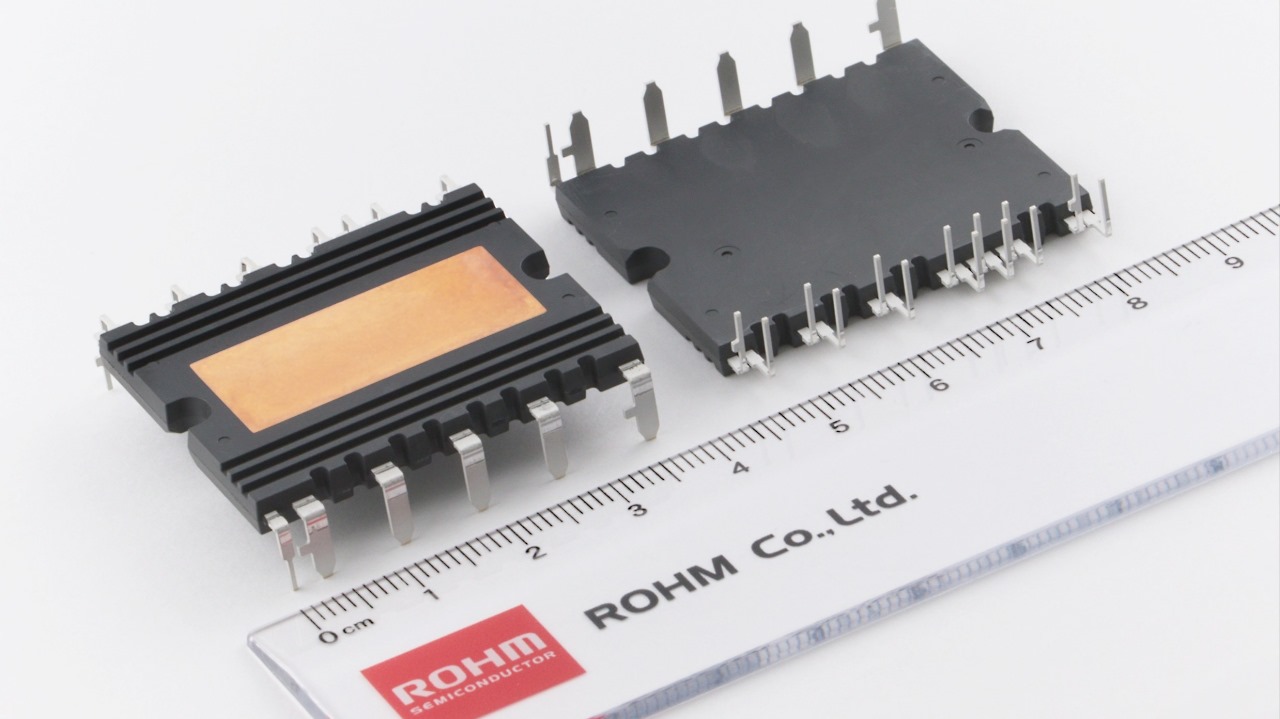
ROHM is not just a component supplier but is moving up the chain into power modules and system-solutions (e.g., TRCDRIVE pack™) for EVs. For example, their TRCDRIVE pack™ is marketed as a “2-in-1 SiC molded module” for EV traction inverters. The focus on SiC (silicon carbide) is strategic: SiC offers higher efficiency, less loss, and supports high-voltage architectures — all key for modern electric vehicles and longer ranges.
ROHM is leveraging its strengths in power/analog semiconductors and automotive reliability (AEC-Q, ISO26262) to secure EV applications. The existence of large-scale, multi-year supply commitments (e.g., >US$1 billion) signals ROHM is recognized as a strategic partner in the EV value chain, not just a commodity parts vendor. The geographic reach (China via ZEEKR, Europe via Vitesco) suggests ROHM is globalizing its EV supply footprint.
Silicon Carbide (SiC) Technology. ROHM is one of the pioneers of SiC power semiconductors. These are essential in EV powertrains, fast chargers, and renewable energy systems. ROHM supplies SiC devices to automakers like Toyota, Hyundai, and Tesla’s suppliers.
Sustainability Focus. The company emphasizes energy-efficient designs and low environmental impact manufacturing. They aim for carbon neutrality by 2050.
Strategic Partnerships. Partnered with STMicroelectronics for SiC wafers. Collaborated with Leadrive Technology (China) for EV inverter systems.
ROHM’s corporate slogan is “Quality is our top priority.” The company’s culture blends Japanese craftsmanship (monozukuri) with advanced engineering, emphasizing reliability, precision, and environmental responsibility.
Start Small, Think Long-Term
ROHM’s journey began with one simple product — resistors. While others chased quick profits, Ken Sato’s vision was to perfect one thing and build a reputation for reliability. This discipline laid the foundation for decades of growth. By the time competitors diversified recklessly, ROHM had already mastered its core. Success often begins with deep expertise in a single product. Whether you make coffee, clothing, or software, mastering your niche first creates the credibility and foundation for future expansion. ROHM began with one focus: building the best resistors in Japan. Instead of chasing trends, Ken Sato focused on mastering his craft and building a trusted name. This patience became ROHM’s greatest strength.
Takeaway: Master one thing first. Build excellence around a single product or service, then expand when your quality speaks for itself.
Invest in Core Technology
ROHM’s biggest advantage lies in its in-house development. From semiconductor design to manufacturing, the company keeps its critical technology internal. This gives them unmatched control over quality, cost, and innovation speed — a major reason automakers and energy firms trust ROHM components. When you own your technology or process, you own your future. Businesses that depend too much on external suppliers risk losing control. For startups, this could mean owning your recipes, your algorithms, or your production molds — the “heart” of your product. ROHM’s defining strength is its control over technology. The company designs and produces most of its components internally — from semiconductors to integrated circuits. This ensures consistency, reliability, and innovation speed.
Takeaway: When you own your core technology or process, you protect your identity and independence. For startups, it could be your formula, code, or design — the DNA of your business.
Turn Sustainability into Profit
Long before it became a global trend, ROHM was investing in energy-efficient components. Its Silicon Carbide (SiC) devices now power electric vehicles, renewable energy grids, and high-efficiency factories worldwide. Rather than treating sustainability as a marketing slogan, ROHM made it part of its business strategy. Sustainability isn’t a cost — it’s an opportunity. If your business reduces waste, energy use, or carbon emissions, that value can translate into both cost savings and customer loyalty. ROHM was pioneering energy-efficient semiconductors. Its Silicon Carbide (SiC) products now power electric vehicles, solar systems, and energy grids across the globe.
Takeaway: Sustainability can be your growth engine. Businesses that contribute to a cleaner, more efficient world will always stay relevant and respected.
Global Mindset, Local Roots
From its headquarters in Kyoto, ROHM expanded to Asia, Europe, and North America. Yet, it never lost its Japanese identity of craftsmanship, discipline, and humility. Every product carries the quiet assurance of “Made with Kyoto Precision.” Expanding globally doesn’t mean abandoning your roots. Instead, let your local heritage become your global brand strength. Customers appreciate authenticity, especially in today’s digital world. ROHM has expanded across Asia, Europe, and North America. Yet, the company maintains its Japanese precision and craftsmanship in every operation. “Made with Kyoto Precision” has become synonymous with quality.
Takeaway: Going global doesn’t mean losing your roots. Your local heritage and values can be your biggest global differentiator.
Grow Through Partnerships
ROHM knows that no company can innovate in isolation. It formed key partnerships with STMicroelectronics for wafer supply and Leadrive Technology in China for EV inverter systems. These collaborations accelerated ROHM’s presence in the booming electric vehicle market. Strategic partnerships can multiply your growth. Align with businesses that share your vision or complement your strengths — from tech and design to logistics or marketing. ROHM thrives through partnerships — collaborating with STMicroelectronics and Leadrive Technology to accelerate innovation in electric vehicle systems.
Takeaway: Strategic partnerships amplify growth. Find partners who complement your strengths and share your long-term vision.
ROHM invests nearly 10% of its annual revenue into research and development. This commitment fuels advancements in SiC and GaN technologies, keeping them ahead of competitors and ready for future markets. Innovation must be a habit, not a one-time project. Even small businesses can innovate — by testing new packaging, improving efficiency, or exploring new materials. ROHM invests nearly 10% of its annual revenue in research and development. This continuous investment keeps it ahead in cutting-edge materials like SiC and GaN, positioning the brand for the next wave of industrial transformation.
Takeaway: Treat R&D as a mindset. Continuous improvement and experimentation are the lifeblood of sustainable growth.
Let Quality Speak Louder Than Marketing
Unlike flashy tech companies, ROHM’s reputation comes from quiet consistency. It rarely advertises aggressively, yet its clients — including global automakers — remain loyal because of decades of dependable performance. Marketing is important, but nothing markets better than trust. In B2B or premium segments, a company’s reliability and after-sales service can be stronger than any campaign. ROHM’s marketing is understated, yet its reputation is powerful. The brand built global credibility by consistently delivering reliable components for over six decades.
Takeaway: In industries where trust matters, consistency is the strongest form of marketing. Let your product performance and reliability build your brand.
Build Resilience Through Vertical Integration
ROHM controls its entire value chain, from component design to packaging. This helped it weather the 2020 global chip shortage with minimal disruption — while competitors struggled with supply issues. Control what you can. Owning key parts of your process — or even diversifying suppliers — protects your business from global shocks. When the 2020 global chip shortage hit, ROHM stayed stable thanks to its vertically integrated operations — managing everything from design to packaging. This independence allowed it to meet customer demand while others struggled.
Takeaway: Control what’s critical to your business. Owning key production or logistics stages can make your company more resilient during crises.
Prepare for the Future, Not Just the Present
ROHM’s biggest markets today — electric vehicles, renewable energy, and robotics — were once considered “future industries.” By investing early, ROHM positioned itself perfectly for the global shift to sustainability and electrification. Anticipate change. Don’t build your business for today’s demand; build it for tomorrow’s inevitabilities. ROHM’s focus on electric vehicles and renewable energy wasn’t a reaction — it was a prediction. Decades before these sectors exploded, the company was already investing in the technologies that now define its leadership.
Takeaway: Build for the future, not the present. Anticipate trends before they become mainstream and invest early.
ROHM’s slogan, “Quality is our top priority,” isn’t just a tagline — it’s a code. Every employee, from factory floor to management, is trained to prioritize quality before cost or speed. This principle, though simple, is what makes ROHM a trusted global supplier. Quality creates trust — and trust creates longevity. In any industry, businesses that refuse to compromise on standards will always outlast those that do.
Takeaway: A clear, consistent philosophy binds people together. When your team aligns around quality and purpose, success follows naturally.
ROHM Japan’s rise from a small Kyoto workshop to a global semiconductor leader proves that quiet discipline often beats loud ambition. Its commitment to craftsmanship, innovation, and sustainable growth offers a timeless blueprint for entrepreneurs everywhere. In a world obsessed with speed, ROHM reminds us that success built on integrity, patience, and quality endures the longest.
ROHM’s story isn’t just about technology — it’s about discipline, long-term thinking, and unwavering commitment to quality. Here are key lessons entrepreneurs can learn from its remarkable journey.
ROHM Japan proves that lasting success doesn’t come from aggressive expansion or loud branding — it comes from craftsmanship, patience, and vision. The company’s focus on quality, sustainability, and continuous innovation offers a timeless lesson for modern entrepreneurs.
As industries evolve, ROHM’s philosophy remains relevant: Build something reliable, improve it constantly, and the world will come to you.