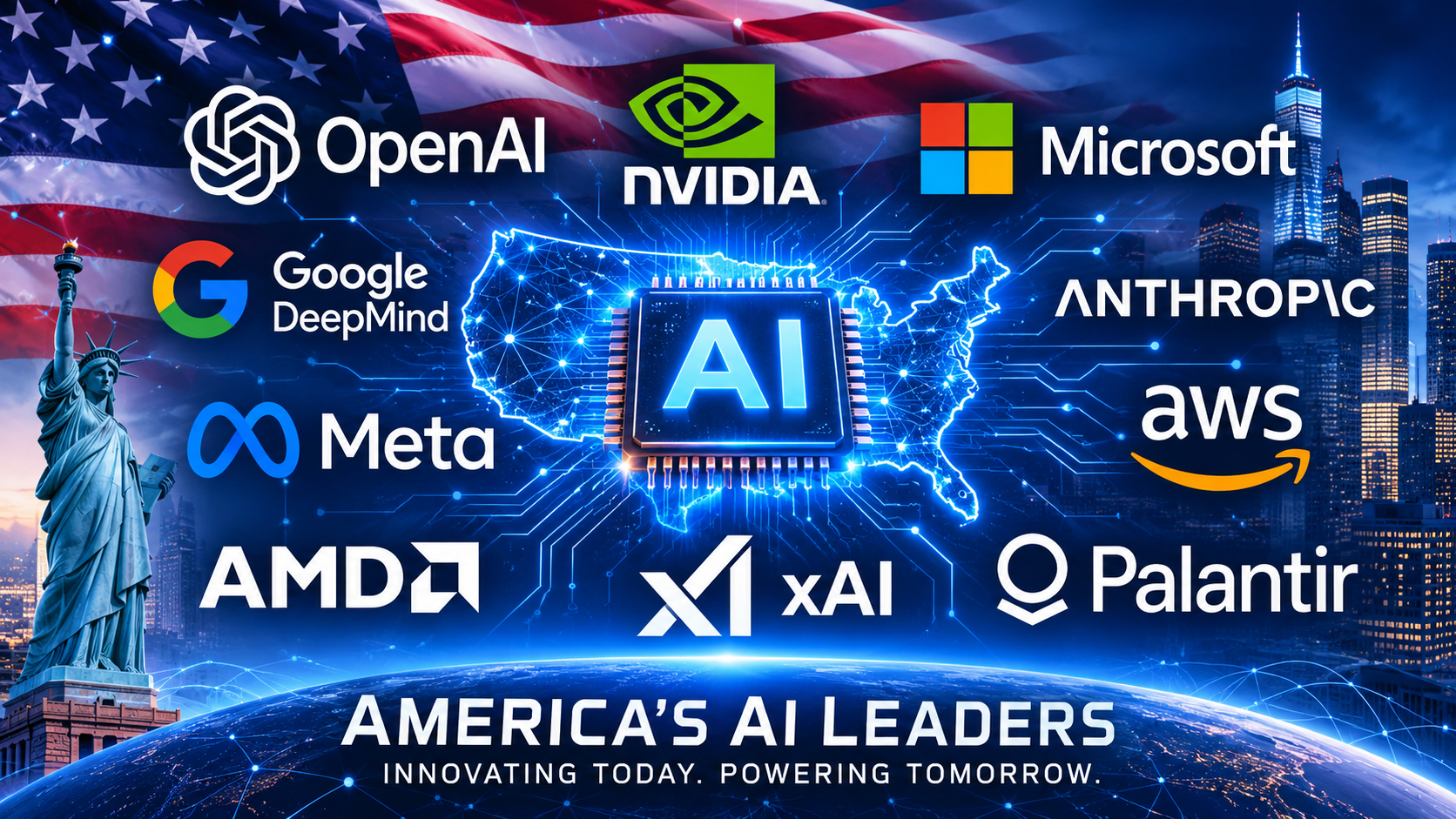
Discover how American AI is reshaping global business, semiconductor industries, investment, employment and the future of the world economy.
Discover how American AI is reshaping global business, semiconductor industries, investment, employment and the future of the world economy.
The Future of Artificial Intelligence and Its Business Potential
Artificial Intelligence (AI) is more than a technology trend. It is developing into a major global industry that could transform how businesses operate, how products are manufactured, how services are delivered and how economies grow.
Artificial Intelligence refers to computer systems capable of performing tasks that traditionally require human intelligence, including learning, reasoning, recognizing patterns, understanding language, generating content and making predictions.
AI is not one single product. It is an ecosystem of technologies, infrastructure and commercial services.
Generative AI à Creates text, images, audio and video à Marketing, Media, Design
Machine Learning à Identifies patterns and predicts outcomes à Finance, Insurance, Retail
Computer Vision à Interprets images and video à Manufacturing, Security
Natural Language Processing à Understands human language à Customer Service, Translation
Robotics & AI à Combines intelligence with physical machines à Factories, Logistics
Predictive AI à Forecasts future events and demand à Supply Chains, Investment
The commercial importance of AI comes from its ability to reduce operating costs, improve productivity, accelerate decision-making and create products and services that were previously difficult or expensive to deliver.
The five layers of the AI economy
Semiconductors and hardware - AI processors, GPUs, memory chips, networking equipment and advanced computing components.
Examples: NVIDIA, AMD, SK Hynix.
Data centers and cloud infrastructure - The physical infrastructure that stores information and provides computing power to AI applications. Examples: Amazon Web Services, Microsoft Azure, Google Cloud.
AI models and platforms - Companies developing the intelligence, algorithms and software that power AI services. Examples: OpenAI, Anthropic, Google DeepMind.
AI applications and software - Commercial products that apply AI to specific industries and business problems. Examples: AI accounting, marketing automation, medical imaging and industrial analytics.
AI consulting and integration - Businesses helping companies adopt, customize, maintain and manage AI systems. Examples: Enterprise AI implementation, automation consulting and AI cybersecurity.
The financial numbers indicate that AI is moving beyond an experimental technology sector. According to Stanford University's 2026 AI Index Report: Global corporate AI investment reached approximately $581.7 billion in 2025, more than doubling from the previous year. Private AI investment increased by 127.5%. Generative AI attracted nearly half of private AI funding. 88% of surveyed organizations reported using AI in at least one business function. Generative AI adoption reached 70% of surveyed organizations.
These figures demonstrate the speed of commercial adoption. However, investment figures should not be confused with actual profits. Many AI businesses are still spending heavily on computing infrastructure, research, talent and customer acquisition. The opportunity is enormous, but the ability to generate sustainable earnings will separate successful companies from businesses that simply benefit from the AI investment boom.
The Future of AI Business
1. AI agents and business automation - AI systems will increasingly perform multi-step business tasks, such as processing invoices, managing customer inquiries, preparing reports and coordinating workflows. Revenue potential: Monthly subscriptions, usage fees and enterprise contracts.
2. AI in healthcare - Medical imaging assistance, clinical administration, drug discovery and hospital workflow optimization. Revenue potential: Software licensing, institutional contracts and specialized services.
3. Industrial AI and manufacturing - Predictive maintenance, automated quality inspection, production planning and intelligent supply chains. Revenue potential: Industrial software, implementation contracts and ongoing maintenance.
4. AI energy and infrastructure - Data centers, electricity generation, cooling systems, energy storage and grid management. Revenue potential: Long-term infrastructure contracts, electricity sales and equipment supply.
5. AI in financial services - Fraud detection, risk assessment, financial analysis, compliance and automated customer services. Revenue potential: Financial software subscriptions, licensing and institutional services.
6. AI-powered commerce and digital media - Personalized shopping, intelligent product discovery, content production, advertising optimization and customer analytics. Revenue potential: Advertising, transaction commissions, subscriptions and integrated commerce.
AI Business Sustainable in the Long Term? AI has strong long-term commercial potential, but not every AI business will be sustainable or profitable. There are three dimensions to consider.
Financial sustainability - A sustainable AI business must generate recurring revenue that exceeds its operating and development costs. Some business models have stronger commercial characteristics than others. AI software subscriptions, Enterprise AI services, AI infrastructure, AI semiconductor design, AI consulting, AI-powered commerce. The most attractive business characteristics include: Recurring subscription income. Low customer acquisition costs. Strong customer retention. Scalable technology. Specialized industry knowledge. Clear productivity or financial benefits for customers. A company that helps a manufacturer save $1 million annually through AI automation has a much clearer commercial proposition than a company simply selling an AI product without demonstrating measurable value.
Technological sustainability - AI technology is developing rapidly, and today's leading companies may not necessarily dominate the market in ten years. There are several risks: New competitors may develop cheaper and more efficient AI models. Open-source AI could reduce the commercial value of some proprietary software. Major technology companies could introduce competing services. Computing costs and hardware requirements could change. Customers may switch providers if competing products deliver better results. The most sustainable AI businesses may not necessarily be those with the most advanced AI models. They may instead be companies that own valuable customer relationships, proprietary data, industry expertise, distribution networks and technology that is difficult to replace.
Environmental sustainability - This is a major challenge for the future of AI. AI requires substantial electricity, water for some cooling systems, semiconductor manufacturing resources and physical infrastructure. According to the International Energy Agency's 2026 research: Data center electricity consumption increased by 17% in 2025. Electricity consumption from AI-focused data centers increased by 50%. Global data center electricity consumption is expected to double by 2030. Major technology companies are increasing investment in renewable energy and other power sources. The industry will increasingly need: Renewable electricity. More energy-efficient AI processors. Advanced cooling technologies. Water-efficient data centers. Better computing efficiency. Responsible electronic waste management. Environmental efficiency is likely to become an important competitive advantage, rather than simply a corporate responsibility initiative.
The Biggest Risks to the AI Investment Boom
AI is attracting enormous investment, but investors should distinguish between the long-term growth of AI and the valuation of individual companies.
AI investment bubble – Overvalued companies and excessive infrastructure spending
High operating costs – Lower profit margins
Technology disruption – Existing products become obsolete
Regulations – Additional compliance costs and restrictions
Energy shortages – Higher operating costs and delayed projects
Competition – Pressure on prices and profitability
Cybersecurity – Financial and reputational damage
The IMF's October 2026 analysis of the AI ecosystem highlights an important development: AI infrastructure investment is becoming increasingly capital-intensive, with external financing expected to play a growing role. This means that even companies with substantial revenues must manage their debt, cash flow and investment returns carefully.
AI Businesses Could Be Most Sustainable
Semiconductor, Data centers, AI software platforms, Enterprise AI integration, Industrial AI solutions, AI-powered commerce, AI education and training. One particularly interesting area is enterprise AI integration. Many established companies do not need to develop their own AI models. They need someone who understands their industry and can implement existing technology to solve actual business problems. This creates opportunities for smaller businesses without requiring the enormous investment associated with building semiconductor factories or hyperscale data centers.
2026–2028 – AI adoption and integration - Businesses increasingly integrate AI into daily operations, customer service, marketing, financial analysis and manufacturing. Main opportunity: AI software, consulting and business automation.
2028–2031 – AI automation and intelligent infrastructure - AI agents, robotics, autonomous systems and advanced computing become more deeply integrated into commercial operations. Main opportunity: Industrial automation, robotics, energy and specialized AI services.
2031–2036 – AI-driven industries - AI could become embedded across entire business ecosystems, influencing product development, manufacturing, transportation, healthcare and international commerce. Main opportunity: Integrated AI platforms, intelligent infrastructure and new technology-driven industries.
Is AI Worth Building a Business Around?
The answer is yes, provided the business is built around a real commercial need rather than simply following the AI trend.
First, invest in problems, not just technology. The most valuable AI companies will solve problems that businesses are willing to pay to eliminate.
Second, prioritize recurring income. Businesses with subscriptions, long-term contracts and established customer relationships may have more predictable revenue than businesses dependent on one-time projects.
Third, build around an existing industry. AI becomes more commercially valuable when combined with expertise in manufacturing, finance, healthcare, logistics, retail and other established industries.
The future of AI will not belong exclusively to the companies developing the most powerful algorithms. It will also create opportunities for businesses that understand how to turn AI capabilities into products, services and measurable economic value. The long-term opportunity is not simply to build an AI company. It is to build a sustainable business that becomes more competitive because of AI. AI is likely to remain an important economic and technological force for years to come. However, sustainable profitability will depend on business models, operating efficiency, customer demand, competitive advantages and responsible resource management.
Artificial intelligence is becoming one of the most powerful forces shaping the global economy. From semiconductor manufacturing and financial services to healthcare, manufacturing, transportation and education, AI is changing how companies compete, how governments operate and how people work. At the center of this transformation is the United States.
Home to some of the world's most influential technology companies, including NVIDIA, Microsoft, Google, Amazon, Meta and OpenAI, America has established itself as a major force in the development of artificial intelligence. Its influence extends beyond software and digital services. It reaches into semiconductor design, cloud computing, data centers, global investment and the infrastructure required to power the next generation of intelligent machines.
The scale of investment reflects the importance of this transformation. According to Stanford University's 2026 AI Index Report, private AI investment in the United States reached approximately $285.9 billion in 2025, significantly exceeding investment in other major markets.
Meanwhile, American technology companies are committing enormous resources to building AI infrastructure, including advanced computing facilities, specialized processors and cloud platforms.
The consequences are increasingly global. Countries that manufacture the hardware, supply the energy, provide the raw materials or adopt AI technologies are becoming part of an interconnected economic transformation led in large part by American innovation.
America Is Building the Foundation of the AI Economy
The United States' influence in artificial intelligence begins with its technology ecosystem. Companies such as NVIDIA and AMD design advanced processors that support AI computing. Microsoft, Amazon and Google provide cloud infrastructure, while OpenAI, Anthropic and other developers build increasingly sophisticated AI models.
Major American AI and Technology Companies
The United States is home to some of the world's most influential artificial intelligence and technology companies. Their businesses cover almost every part of the AI industry, from designing advanced computer chips and developing AI models to building cloud infrastructure, enterprise software, robotics and data-analysis platforms. These companies do not all compete in the same market. Some build the technology that makes AI possible; others develop the AI systems themselves or bring AI into everyday business operations. Below is a closer look at the 10 companies, their core businesses, AI strategies, competitive strengths and potential impact on the global economy.
OpenAI
Headquarters: San Francisco, California Main business: AI research, models, products and developer platforms. Official website: openai.com OpenAI is one of the most influential companies in the modern AI industry. It is best known for developing ChatGPT, but its business extends far beyond a conversational chatbot. Key products and technologies: ChatGPT: An AI assistant for writing, research, analysis, learning, planning and business productivity. GPT models: The underlying AI models that understand and generate language, reason through problems and support other tasks. OpenAI API: Allows developers and businesses to integrate AI into their own applications, websites and systems. Codex: AI-powered software development and coding capabilities. Business and enterprise solutions: AI tools designed to support employees, automate workflows and help organizations use their own information. OpenAI generates business through paid subscriptions, enterprise agreements, API usage and other AI services. Its commercial opportunity is to become a major intelligence platform used by individuals, developers and companies. OpenAI helped bring generative AI into mainstream business and public awareness. Its technology is changing how people produce content, conduct research, develop software, communicate and manage information. For a media and commerce business, AI can assist with editorial research, content production, customer support, product discovery and personalization.
NVIDIA
Headquarters: Santa Clara, California Main business: AI chips, GPUs, data-center infrastructure and computing software. Official website: nvidia.com NVIDIA is arguably the most strategically important hardware company in the AI revolution. It designs the processors and computing platforms used to train and operate many of the world's most advanced AI systems. Key products and technologies: GPU (Graphics Processing Unit): A processor capable of handling large numbers of calculations in parallel, making it highly useful for AI. NVIDIA Blackwell and newer GPU platforms: Advanced computing architectures designed for large-scale AI workloads. CUDA: A software platform that allows developers to program NVIDIA GPUs for AI, scientific computing and other applications. Networking technology: High-speed connections that allow thousands of processors to work together. Automotive and robotics: Computing platforms for autonomous driving, simulation and intelligent machines. NVIDIA sells GPUs, complete server systems, networking products, software and related services. Its Data Center business has become a central source of growth because cloud providers and AI companies need enormous computing capacity. AI models require substantial computing power. NVIDIA supplies much of the infrastructure that makes advanced AI possible. Its influence therefore extends beyond its own products into cloud computing, semiconductor manufacturing, energy demand and global technology competition. One important distinction: NVIDIA designs its chips but relies on specialist manufacturing partners, including Taiwan's TSMC, to fabricate many of its advanced processors.
Microsoft
Headquarters: Redmond, Washington Main business: Software, cloud computing, enterprise technology and AI. Official website: microsoft.com Microsoft is one of the world's largest technology companies, with a business ecosystem that includes Windows, Microsoft 365, Azure, LinkedIn, GitHub and Xbox. Its AI strategy is to integrate artificial intelligence into products and services already used by millions of people and organizations. Key products and technologies: Microsoft Copilot: AI assistance across productivity, business and development applications. Azure: Microsoft's cloud-computing platform, providing AI infrastructure and services to businesses. Microsoft Foundry: A platform for developing, customizing and deploying AI applications and agents. Microsoft 365: AI capabilities integrated into Word, Excel, PowerPoint, Outlook and Teams. GitHub Copilot: AI assistance for software developers. Microsoft earns revenue from software subscriptions, cloud services, enterprise contracts, licensing, gaming and hardware. AI strengthens these existing businesses while creating additional demand for Azure computing services. Microsoft has a major advantage: it already has deep relationships with businesses around the world. Rather than asking every company to adopt an entirely new technology environment, Microsoft can introduce AI into software that employees already use. This gives it an important role in the adoption of AI across banking, manufacturing, education, professional services and government.
Google DeepMind
Headquarters: Mountain View, California, with major research operations internationally Main business: AI research, foundation models and scientific applications. Official website: deepmind.google Google DeepMind is Google's principal AI research organization. It combines the expertise of Google Brain and DeepMind, bringing together researchers, engineers and scientists working on advanced AI systems. Its work extends beyond commercial chatbots into scientific discovery, mathematics, robotics, computing and other complex fields. Key products and technologies: Gemini: Google's family of generative AI models. AlphaGo: A landmark AI system that defeated a world champion Go player. AlphaFold: An AI system that predicts protein structures and has become important in biological research. AI research: Work on reasoning, multimodal systems, reinforcement learning and advanced scientific applications. Google AI infrastructure: Research and technology that support AI features across Google's products and services. Google DeepMind is part of Google, which operates within Alphabet. Its research supports commercial products such as Google Search, Workspace, Cloud and Gemini, while also advancing Google's long-term technological capabilities. Google DeepMind illustrates that AI is not simply a software business. It can become a scientific tool that helps researchers investigate diseases, understand biological systems, improve weather forecasting and accelerate discoveries. Its work could have long-term consequences for healthcare, pharmaceuticals, agriculture, materials science and energy.
Anthropic
Headquarters: San Francisco, California Main business: AI models, enterprise AI and AI safety research. Official website: anthropic.com Anthropic is an AI company founded by former OpenAI employees. It has become a major competitor in the development of advanced AI models, particularly for professional and enterprise use. Its central product family is Claude. Key products and technologies: Claude: A family of AI assistants and models designed for writing, analysis, research and problem-solving. Claude Code: AI-assisted software development and coding. Claude API: Tools for developers to integrate Claude into their own applications. Enterprise AI: Solutions for companies that want to incorporate AI into business processes. AI safety research: Work on making advanced AI systems more reliable, controllable and aligned with human intentions. Anthropic earns revenue from subscriptions, API usage and enterprise contracts. It also works with cloud and technology partners to make its models available to a broader range of customers. Anthropic is particularly important in the competition for professional AI applications. Businesses need more than a system that can answer questions; they need AI that can help analyze documents, write code, process information and support complex workflows. Its emphasis on safety and reliability is also relevant as companies consider using AI in sensitive operations.
Meta
Headquarters: Menlo Park, California Main business: Social media, digital advertising, AI models and digital infrastructure. Official website: about.fb.com Meta is the parent company of Facebook, Instagram, WhatsApp and other technology platforms. It is also investing heavily in AI infrastructure and model development. Unlike companies that primarily sell AI software, Meta has a huge existing consumer and advertising ecosystem in which it can deploy AI. Key products and technologies: Meta AI: An AI assistant integrated into Meta's consumer platforms. Llama: Meta's family of open-weight AI models, which developers can use and adapt under their applicable licenses. AI-powered advertising: Tools that help advertisers create campaigns, improve targeting and optimize performance. Recommendation systems: AI technology that determines which content users see across Facebook and Instagram. AI infrastructure: Data centers, specialized processors and large-scale computing systems to support its AI ambitions. Meta's main revenue engine remains digital advertising. AI helps improve advertising performance, content recommendations and user engagement. It also creates opportunities for business messaging and new enterprise services. Meta has access to a massive global audience. If AI becomes more deeply integrated into social media, messaging and online shopping, Meta could become an important platform for AI-powered customer interaction and digital commerce. Its investments in AI infrastructure also demonstrate the scale of resources required to compete in this industry.
Amazon Web Services (AWS)
Headquarters: Seattle, Washington (Amazon); AWS has major operations in Northern Virginia. Main business: Cloud computing, AI infrastructure and enterprise technology. Official website: aws.amazon.com Amazon Web Services is one of the world's largest cloud-computing providers. Its business is to provide companies with the computing infrastructure, storage, databases and software services needed to operate digital businesses. AWS is particularly important to AI because advanced models require enormous computing resources. Key products and technologies: Amazon Bedrock: A platform that allows businesses to access and build applications using different AI models. Amazon SageMaker: Tools for developing, training and deploying machine-learning models. AWS Trainium: Amazon-designed AI chips for training and running AI models. AWS Inferentia: Specialized processors designed for AI inference. Amazon Nova: Amazon's family of AI models. Cloud infrastructure: Data centers, storage, networking and computing services. AWS earns revenue by charging businesses for cloud computing, storage, databases, AI services and other infrastructure. Its customers range from startups to major international corporations and government organizations. AWS makes it possible for companies to use sophisticated AI without having to build their own massive data centers.
For example, a financial institution, manufacturer or online retailer can develop AI applications using AWS infrastructure rather than investing billions of dollars in its own computing facilities. AWS is also part of a wider AI ecosystem, working with companies such as NVIDIA and OpenAI.
AMD
Headquarters: Santa Clara, California Main business: Semiconductors, processors, graphics and AI computing. Official website: amd.com AMD, or Advanced Micro Devices, is one of the most important semiconductor companies in the United States. It competes in the processor and graphics markets and is increasingly focused on AI data-center infrastructure. AMD is particularly significant because it provides an alternative to NVIDIA in the market for AI accelerators. Key products and technologies: AMD EPYC: Server processors used in cloud computing and enterprise data centers. AMD Ryzen: Processors for desktop and laptop computers. AMD Instinct: GPU accelerators designed for AI and high-performance computing. AMD ROCm: Software platform for developing and running applications on AMD GPUs. AMD Helios: A rack-scale AI infrastructure platform combining processors, accelerators, networking and software. AMD earns revenue from selling processors, graphics products, data-center hardware and related technologies. It serves computer manufacturers, cloud providers, enterprise customers and technology companies. The AI chip market needs more than one supplier. Competition between AMD and NVIDIA could give cloud providers and AI companies more choices, encourage innovation and potentially improve the economics of AI computing. AMD's partnerships with major AI companies demonstrate its growing position in the infrastructure market.
xAI
Headquarters: United States Main business: Generative AI models, AI infrastructure and AI applications. Official website: x.ai xAI is an AI company founded by Elon Musk. Its main AI product is Grok, a family of generative AI models and assistants. The company has pursued a strategy that combines model development, large-scale computing infrastructure and access to the wider X social media ecosystem. Key products and technologies: Grok: An AI assistant capable of answering questions, analyzing information and generating content. Grok models: AI models designed for language, reasoning and other tasks. Real-time information: Integration with the X platform can provide access to current public conversations and information. AI infrastructure: Large computing facilities used to train and operate its models. Developer tools: Services that allow developers to access and integrate Grok capabilities. Its commercial opportunities include paid AI subscriptions, developer API services, enterprise applications and integration with other digital platforms. xAI represents the competition to develop powerful AI systems outside the established Google, Microsoft and OpenAI ecosystems. Its relationship with X also creates an interesting business model: combining AI technology with a social platform and a large stream of user-generated information. The company is worth watching because competition in AI increasingly depends on access to computing power, data, talent and distribution.
Palantir Technologies
Headquarters: Denver, Colorado Main business: Data analytics, enterprise software, AI integration and decision-support systems. Official website: palantir.com Palantir is different from most of the companies on this list. It is not primarily a chip manufacturer or a developer of general-purpose AI models. Instead, it specializes in helping organizations connect large amounts of data and turn that information into operational decisions. Key products and technologies: Palantir Gotham: Software used in defense, intelligence and government operations. Palantir Foundry: A data-management and analytics platform for commercial organizations. Palantir Artificial Intelligence Platform (AIP): Connects AI models to company data and business operations. Palantir Apollo: Technology for deploying, updating and managing software across different computing environments. AI agents and automation: Tools that help businesses automate workflows and coordinate operational decisions. Palantir earns revenue from government and commercial contracts, software platforms, implementation and related services. Many companies have accumulated enormous quantities of information but struggle to turn that data into useful decisions. Palantir addresses this challenge by connecting data, AI and business operations. For example: A manufacturer can identify production bottlenecks. A logistics company can optimize inventory and transportation. An energy company can monitor infrastructure and anticipate operational problems. A government organization can analyze complex security and intelligence information. Palantir's business is a useful example of how AI can move from answering questions to influencing real operational decisions.
These businesses operate in different segments, but their technologies are interconnected. AI requires enormous computing capacity. Training advanced models involves processing vast amounts of information through specialized semiconductor chips. Once developed, those models require powerful data centers and cloud infrastructure to serve millions of users and businesses. This creates an entirely new investment economy.
NVIDIA has become particularly important because its graphics processing units, or GPUs, are widely used in AI development. Its CUDA software ecosystem also gives developers an established platform for building AI applications. Microsoft, Google and Amazon are investing in their own AI infrastructure and specialized processors, seeking to reduce computing costs and strengthen their competitive positions. The result is an industry in which hardware, software, data and computing infrastructure increasingly determine economic competitiveness.
The Global Semiconductor Industry Is Benefiting
America's AI expansion is also creating opportunities for semiconductor manufacturers and technology suppliers around the world. Although many leading AI chips are designed by American companies, their manufacturing depends heavily on international partners.
Taiwan's TSMC plays a central role in manufacturing advanced processors, while South Korean companies Samsung Electronics and SK Hynix are important suppliers of memory technologies, including high-bandwidth memory used in AI systems.
Japan contributes semiconductor materials, manufacturing equipment and precision components. The Netherlands is home to ASML, a critical supplier of advanced lithography equipment used in semiconductor production.
This interconnected supply chain means that American AI investment can generate economic activity far beyond the United States. According to the Federal Reserve's February 2026 analysis, the expansion of AI infrastructure has already increased international demand for data center equipment and high-technology components. AI-related goods contributed nearly half of merchandise trade growth in the first half of 2025, despite representing a much smaller share of overall trade.
For Asian manufacturing economies, this represents an important opportunity. Countries supplying electronic components, advanced materials, semiconductor equipment and industrial infrastructure may benefit from continued expansion in global AI investment.
AI Is Changing How Businesses Operate
Perhaps the most significant long-term impact of American AI development will be its influence on everyday business operations. Artificial intelligence is moving beyond experimental technology and becoming integrated into commercial activities. In financial services, AI can help analyze financial markets, detect suspicious transactions, assess credit risks and automate customer support. In manufacturing, intelligent systems can monitor production lines, predict equipment failures, improve quality control and optimize supply chains.
Retailers can use AI to analyze purchasing behavior, manage inventories, personalize recommendations and improve customer experiences. Professional service companies are also adopting AI to accelerate research, document processing, marketing, accounting and administrative work. For smaller businesses, the opportunity could be particularly significant. Previously, sophisticated analytical tools and specialized software were often available only to companies with substantial technology budgets. Cloud-based AI services are making many of these capabilities accessible through subscriptions and relatively affordable digital platforms.
However, adopting AI does not automatically guarantee better performance. Companies still need reliable data, skilled employees, appropriate technology and effective management to translate AI capabilities into measurable productivity gains.
The Global Workforce Faces a Major Transformation
AI is also changing the relationship between technology and employment. Some repetitive tasks in administration, customer service, data processing, content production and basic research can increasingly be performed or supported by AI systems. This creates opportunities for companies to improve efficiency, but it also raises questions about the future of certain occupations. The impact is unlikely to be uniform.
Some jobs may disappear or require fewer employees, while others will evolve to include AI-assisted responsibilities. New demand is also emerging for specialists in AI engineering, cybersecurity, data management, robotics and digital infrastructure. For developing economies, the challenge is particularly important. Countries with large workforces in business processing, customer support, manufacturing and administrative services may experience both productivity opportunities and competitive pressure. The long-term advantage may belong to economies that invest in education, digital skills and the ability to integrate AI into existing industries.
AI Is Becoming a New Geopolitical and Economic Battleground
Artificial intelligence is no longer simply a competition between technology companies. It has become an important consideration in national economic strategy and international relations. The United States is seeking to maintain its leadership in advanced AI models, semiconductor technology and computing infrastructure. China is developing its own AI ecosystem, semiconductor capabilities and domestic technology platforms.
Europe is pursuing a regulatory and industrial approach, while countries in the Middle East are investing heavily in data centers and digital infrastructure. The competition extends into semiconductor supply chains, critical minerals, energy security, data governance and access to advanced computing technologies.
Access to leading AI chips is particularly important. Governments increasingly view advanced computing capacity as a strategic resource, and American export controls have made access to certain high-performance semiconductor technologies an important international policy issue. For other countries, this creates a difficult balancing act. They want access to American technology and investment, but they also want to develop domestic capabilities and avoid excessive dependence on a single foreign technology ecosystem. The future AI economy will therefore be shaped not only by technological breakthroughs but also by trade policy, international partnerships and competition between major economic powers.
The Infrastructure Challenge Behind the AI Boom
One of the less visible consequences of artificial intelligence is its enormous demand for electricity and physical infrastructure. AI data centers require specialized processors, advanced cooling systems, high-speed networking and reliable power supplies. The International Energy Agency's 2026 report, Powering Artificial Intelligence, highlights the scale of this transformation. Global investment by major data center operators is expected to exceed $700 billion in capital expenditure during 2026.
This investment creates opportunities for energy companies, construction contractors, electrical equipment manufacturers, cooling technology providers and infrastructure developers. However, it also creates challenges. Electricity demand is increasing, while some regions face limitations in grid capacity and the time required to connect new data centers. Water consumption, environmental considerations and local infrastructure costs are becoming important issues for governments and communities. The next phase of the AI industry will therefore depend not only on faster processors and more advanced software, but also on the availability of affordable energy and supporting infrastructure.
What American AI Means for Emerging Economies
For countries such as Indonesia, India, Vietnam and other developing markets, the expansion of American AI presents an important economic opportunity. These economies do not necessarily need to compete directly with Silicon Valley in developing the world's most advanced AI models. Instead, they can focus on applying AI to industries where they already have commercial advantages.
Indonesia, for example, has opportunities to introduce AI across manufacturing, agriculture, mining, logistics, banking, retail and public services. Manufacturers could use AI to improve production planning and quality control. Agricultural businesses could apply predictive analytics to improve crop management. Logistics companies could optimize transportation networks and warehouse operations. Financial institutions could improve fraud detection and customer services, while retailers could use AI to understand consumer demand and improve inventory management.
There is also an opportunity to develop local technology businesses that integrate international AI platforms with regional market knowledge. However, realizing these benefits requires investment in digital infrastructure, reliable electricity, education, cybersecurity and data governance. Countries that successfully combine AI technology with their existing industrial capabilities may become more competitive in international markets.
The Risks Behind the Opportunity
Despite its potential, the AI industry faces several important risks. First, the enormous capital investment required to build AI infrastructure raises questions about long-term financial returns. If demand does not grow as quickly as expected, some companies could face excess capacity and pressure on profitability.
Second, the concentration of advanced AI technology among a relatively small number of companies creates concerns about market power and dependence on major technology providers. Third, cybersecurity, data privacy, misinformation and intellectual property protection remain significant challenges.
There is also the question of whether the productivity benefits of AI will be distributed broadly across society or concentrated among companies and economies that control the technology. The Federal Reserve's November 2026 research on AI and the US economy notes that adoption is increasing, but measurable effects on overall productivity and employment remain relatively limited and mixed so far.
This is an important distinction: enormous investment and technological progress do not automatically translate into immediate economy-wide productivity gains. Businesses must still learn how to use AI effectively.
The Next Global Economic Advantage
The rise of American artificial intelligence represents more than another technology cycle. It is creating a new economic ecosystem involving semiconductors, cloud computing, energy, manufacturing, finance and international trade. The United States currently occupies a central position because of its leading technology companies, investment capital, research institutions and AI infrastructure. But the benefits and competitive consequences extend far beyond American borders.
Taiwan and South Korea are important to advanced semiconductor production. Japan and the Netherlands supply critical industrial technologies. Emerging economies have opportunities to apply AI to manufacturing, services and domestic industries. For businesses, the message is increasingly clear: artificial intelligence is becoming an important component of long-term competitiveness.
The companies and countries that understand how to combine technology, investment, infrastructure and human expertise may be better positioned to participate in the next phase of global economic growth.
America may be leading the development of the AI economy, but the transformation it is creating will belong to the world.