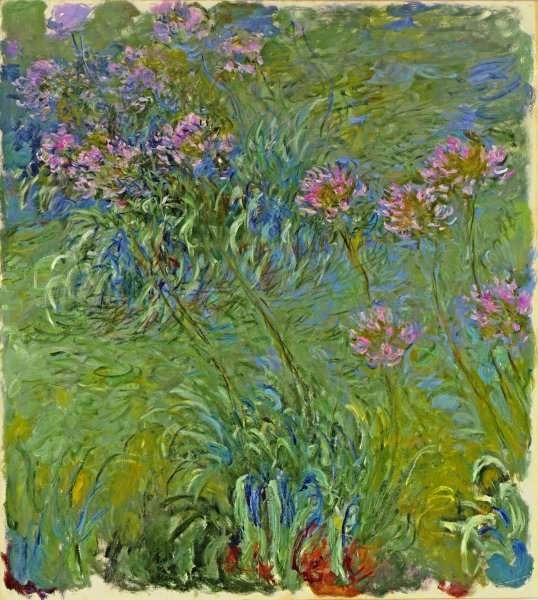
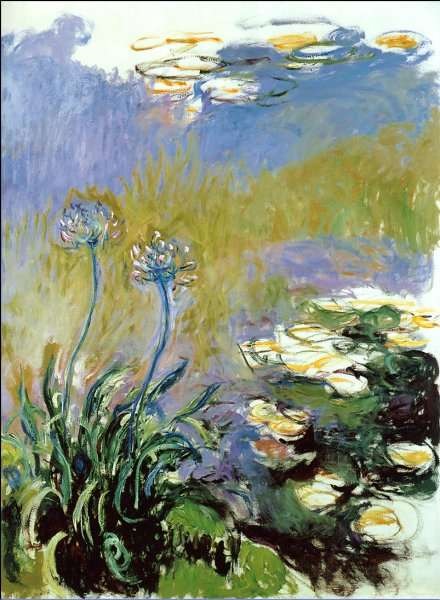
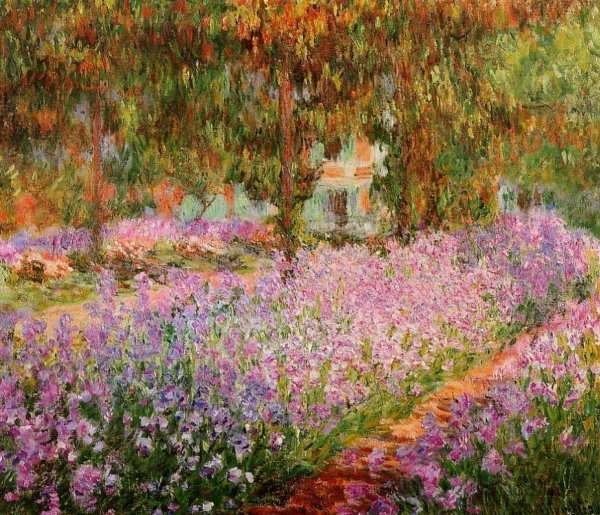
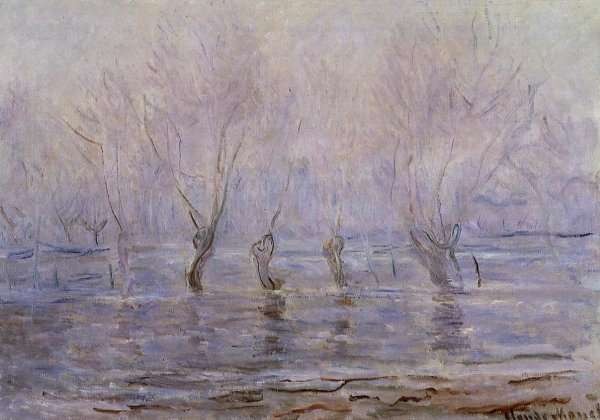
Claude Monet’s Giverny reveals how art, gardens, architecture and everyday life became one beautifully designed world of color, nature and light.
Claude Monet’s Giverny reveals how art, gardens, architecture and everyday life became one beautifully designed world of color, nature and light.
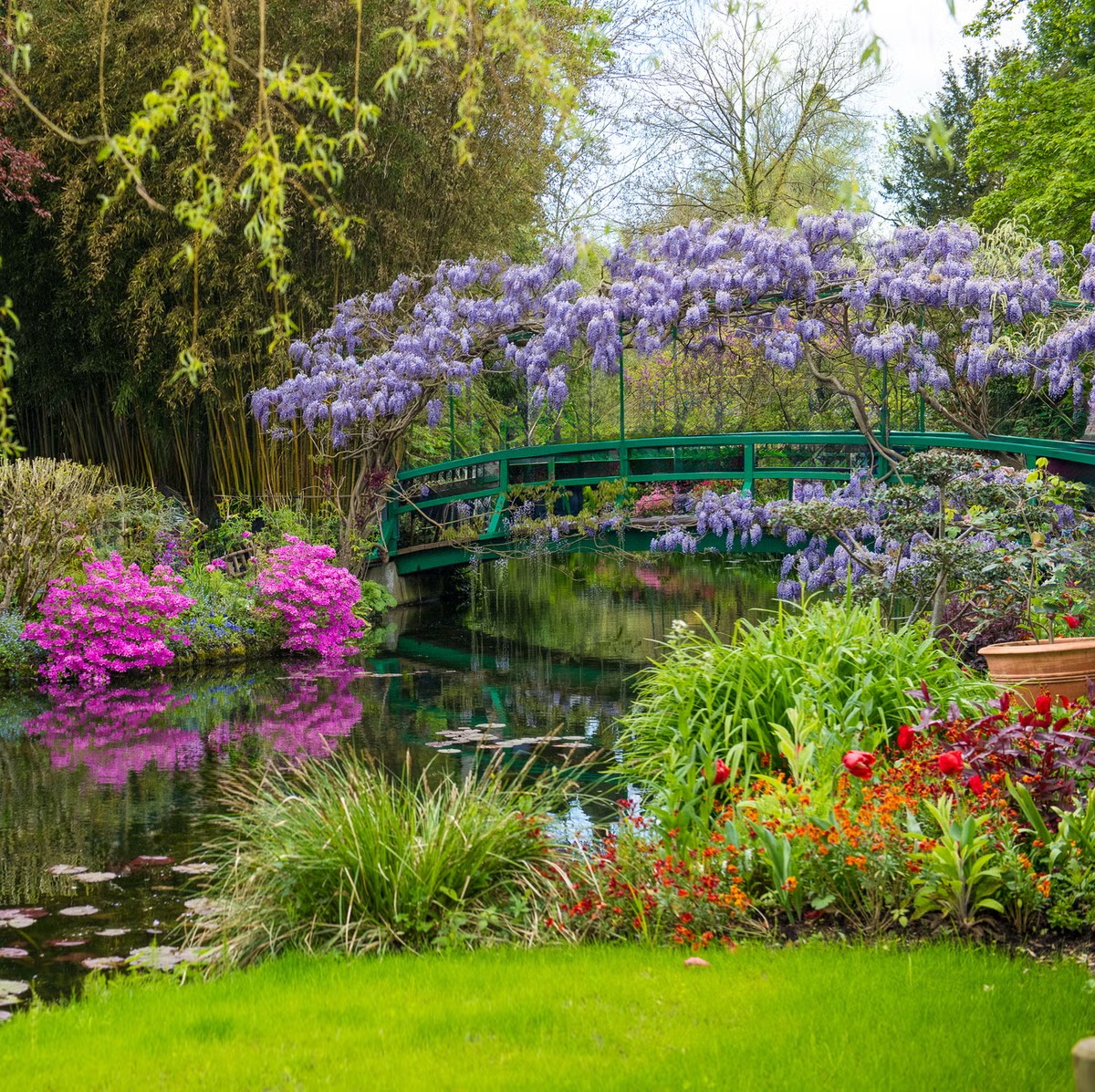
Image courtesy of Olga Matveeva/Getty Images
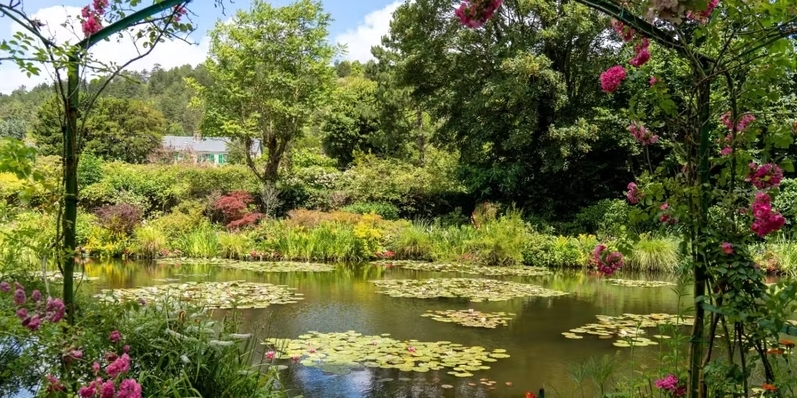
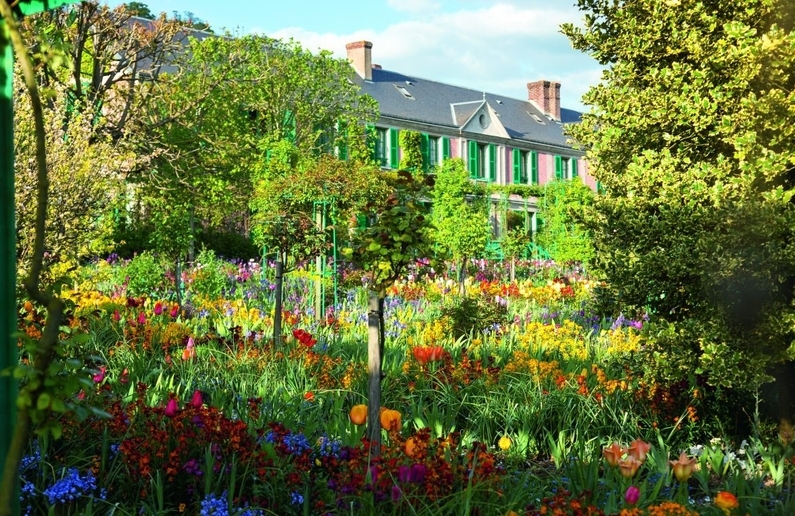
Monet moved to Giverny in 1883 and remained there until his death in 1926. He didn't simply live in the garden—he designed and cultivated it as an artistic environment. The garden gradually became one of his greatest sources of inspiration. There are essentially two gardens: Clos Normand — the flower garden directly in front of the house. The Water Garden — the famous pond with water lilies, Japanese-style bridge and surrounding plants.
Clos Normand — the flower garden
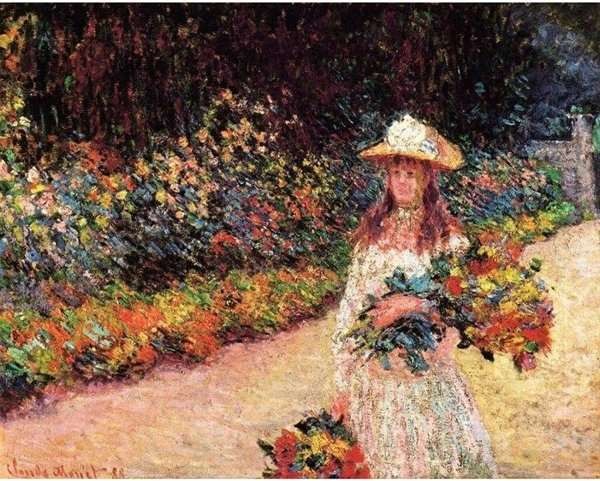
This is the more colorful, almost "painting-like" garden. Monet arranged flowers according to color, height, perspective and seasonal changes, rather than creating a conventional formal garden. Roses, hollyhocks, irises, nasturtiums, daisies and other flowers create layers of color along the paths. An interesting aspect is that Monet was not merely a painter who happened to have a beautiful garden. He was deeply involved in gardening and plant selection, exchanging plants with other horticultural enthusiasts and spending considerable time directing the garden's development.
The Water Garden — the famous part
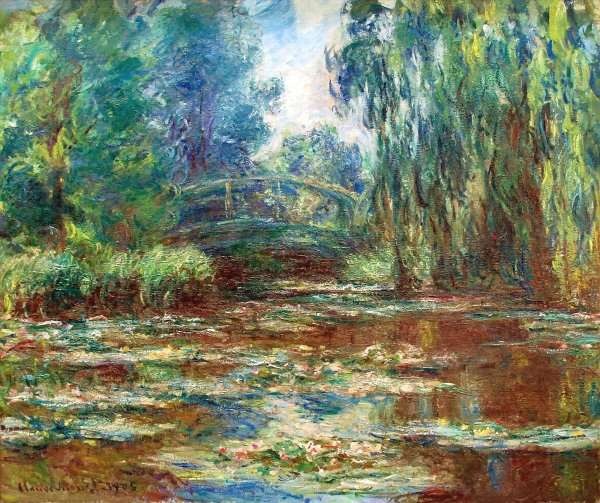
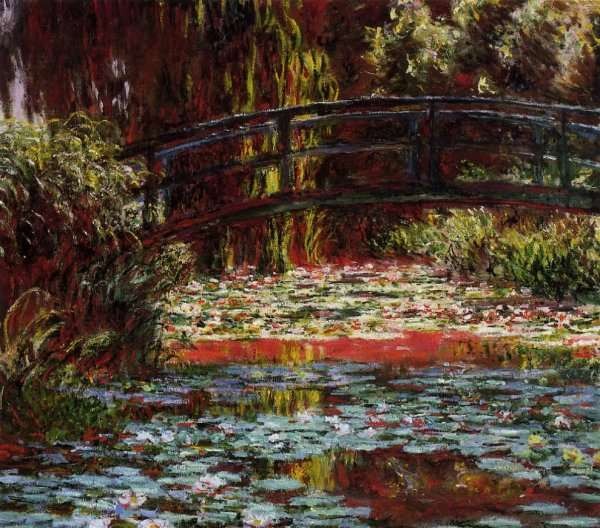
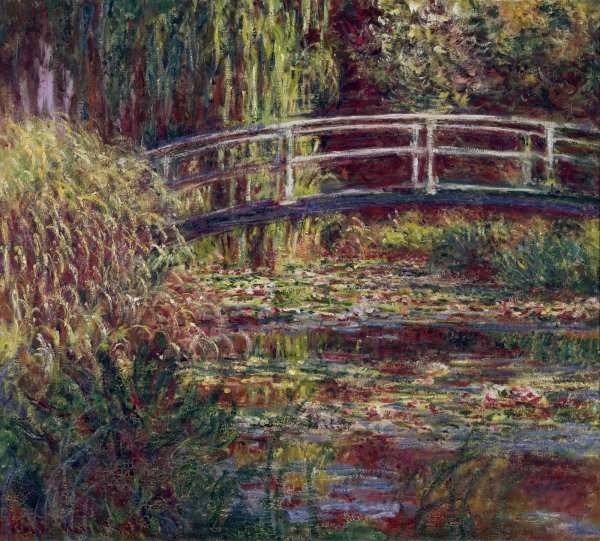
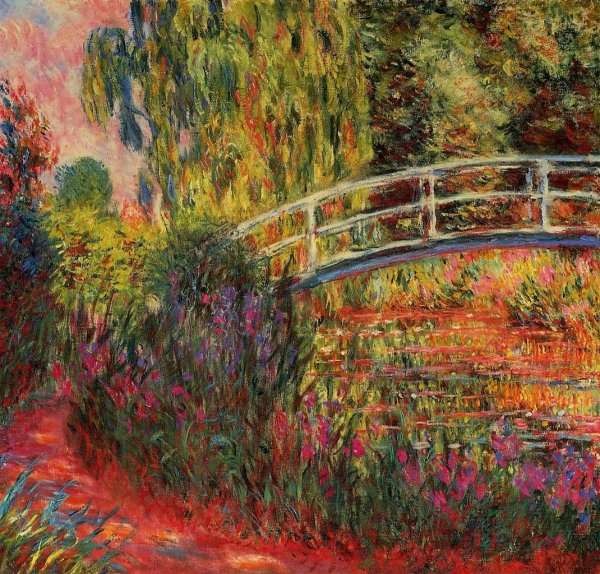
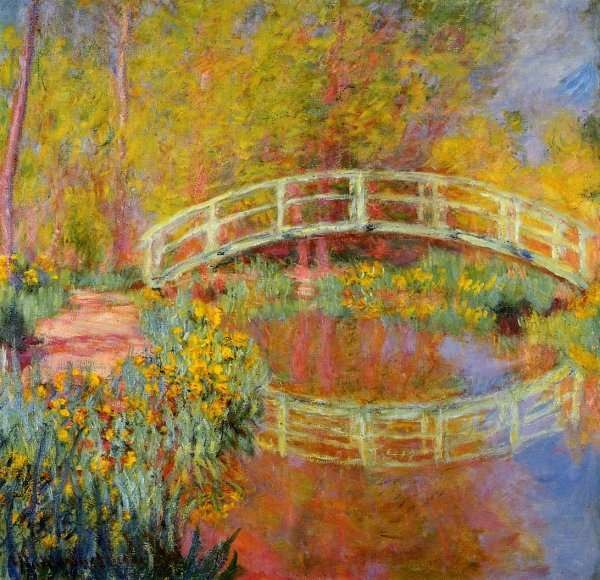
This is probably what most people picture when they hear "Monet's Garden." In 1893, Monet acquired land across from his property and developed a water garden. He had water diverted into the area and eventually created the pond that became the subject of his famous Water Lilies / Nymphéas paintings. The garden contains: Water lilies. Bamboo. Japanese maples. Ginkgo. Japanese peonies. Weeping willows. A Japanese-style arched bridge. The bridge was constructed in the 1890s and became one of Monet's most recognizable motifs.
The fascinating part — Monet created the subject himself. This is what makes Giverny particularly interesting from an art-history perspective. Monet is famous for painting nature as he observed it, particularly changing light and atmosphere. But at Giverny, he also constructed the landscape that he then painted.
The pond, bridge, water lilies and surrounding vegetation weren't simply a beautiful piece of untouched countryside that Monet happened to discover. He deliberately shaped the environment. The National Gallery of Art notes that Monet designed the landscape represented in his Japanese Footbridge paintings—from the pond and bridge to the plantings.
So you can think of Giverny as: Garden → Inspiration → Painting → Garden becomes famous → Garden becomes part of art history
The Water Lilies connection
From around 1897 onward, Monet increasingly concentrated on the water lilies and pond. His interest shifted away from depicting an identifiable landscape toward water, reflections, light, color and atmosphere. The surface of the pond could become almost abstract. This eventually produced the enormous Nymphéas series, some of which are now among the most famous works of Impressionism. That's why Giverny isn't simply a beautiful French garden. It was effectively Monet's living studio.
Monet died at Giverny in 1926. His son Michel inherited the property, but after the Second World War the house and gardens deteriorated significantly. Michel eventually left the property to the Académie des Beaux-Arts. Beginning in the late 1970s, the property underwent extensive restoration. The Fondation Claude Monet was established in 1980, and the house and gardens opened to the public. Today it is one of Normandy's major tourist attractions. The official site currently lists the 2026 visiting season as April 1 through November 1, 10:00–18:00, with last admission at 17:30.
Claude Monet’s garden at Giverny is much more than a beautiful flower garden. From a landscape-design perspective, it is an unusually sophisticated example of a garden being designed simultaneously as a living landscape, visual composition, sensory experience, and source of artistic inspiration.
Monet lived at Giverny from 1883 until his death in 1926, continually modifying the gardens. The design is essentially divided into two contrasting environments: the Clos Normand, a relatively geometric flower garden in front of the house, and the Water Garden, a more naturalistic, curving Japanese-inspired landscape across the road.
The most important idea behind Monet's landscape is: He designed the garden like a painter designs a canvas. The official Giverny foundation describes Monet as both an artist and an inventive gardener who arranged his garden "like an artwork." Instead of beginning with conventional garden principles such as symmetry, formal hedges or architectural ornament, Monet was interested in: color, light, reflection, perspective, seasonal change, movement, plant texture, visual depth, framing, contrast, repetition and atmosphere.
The University of Virginia's landscape-architecture study of Giverny specifically identifies the contrast between the geometrically arranged flower garden and the curvilinear water garden as fundamental to the design.
Clos Normand — the garden as a color composition
The Clos Normand is the garden directly in front of Monet's house. When Monet arrived in 1883, the approximately one-hectare garden contained an orchard and kitchen garden. There was a central path bordered by conifers and flower beds edged with clipped boxwood. Monet progressively transformed this arrangement.
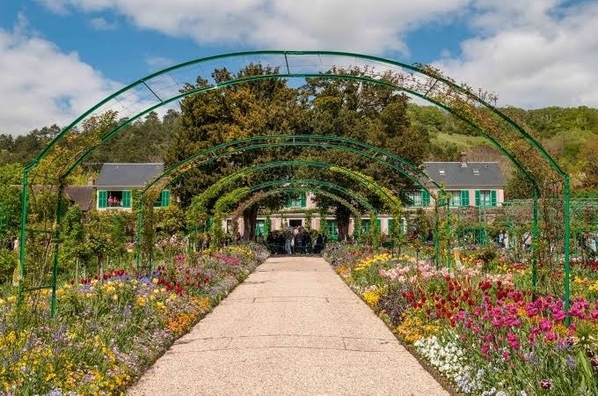
He removed much of the existing formal structure, including the boxwood and many of the spruce trees, replacing the latter with metal arches. Fruit trees were also changed, including the introduction of Japanese cherry and apricot trees.
Instead of a traditional formal French garden, Monet created something much more fluid: house → path → arches → flowers → trees → visual depth. The garden still has geometry, but the geometry becomes a framework for plants rather than an attempt to control them completely.
Perspective was deliberately engineered
One of Monet's most interesting landscape-design techniques was perspective. The official Giverny description specifically notes that Monet used his knowledge as a painter to create perspective effects, showcase the house and intensify shaded areas. Think about how a painter creates depth: foreground → middle ground → background. Monet essentially reproduced that principle in three dimensions.
Foreground. Low flowers and pathways.
↓
Middle ground. Roses, climbing plants, taller flowers.
↓
Background. Trees, arches and the house.
The visitor therefore doesn't experience the garden as one flat field of flowers. Instead, the eye is continually moving forward.
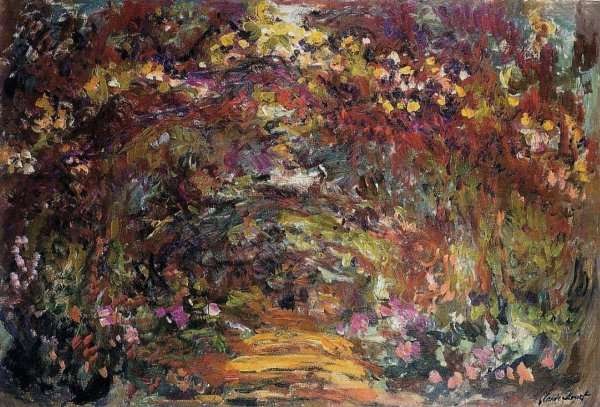
The central axis. The central path is an important organizing element. Originally, the property had a strong central axis leading toward the house. Monet retained the importance of the central movement but changed the planting character around it. The path creates: Entrance → movement → discovery → house. But Monet softened the architectural character through vegetation. Metal arches covered with climbing plants create a sequence of thresholds. This is a classic landscape-design principle: Reveal the garden progressively. Rather than showing everything immediately, the visitor moves through a series of visual frames.
Vertical layering. Monet was particularly effective at creating different planting heights. The Giverny garden uses layers such as: Low; annual flowers – bulbs - ground-level planting. Medium; irises – peonies – roses - other flowering plants. High; hollyhocks - climbing roses - fruit trees - ornamental trees. The resulting effect is almost like a three-dimensional painting. The Giverny garden is documented as using flower groups of different heights to create volume, with fruit and ornamental trees rising above roses, hollyhocks and lower annuals.
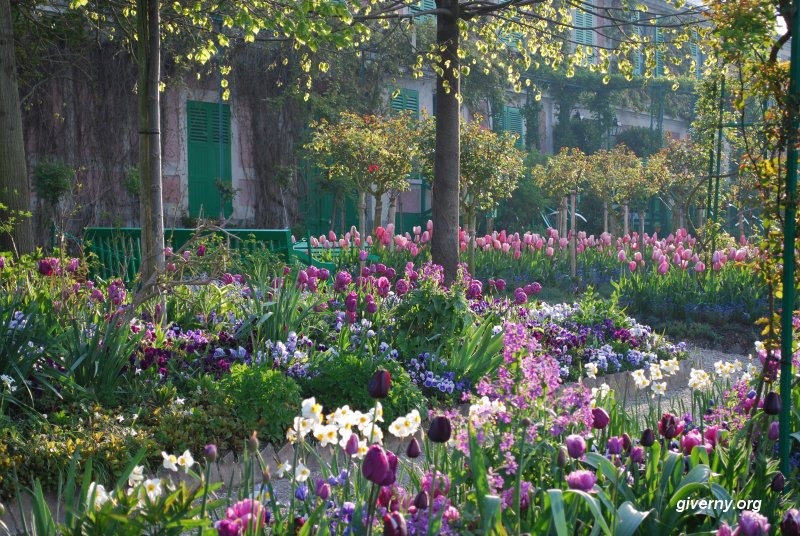
Monet treated flowers like a painter's palette. This is one of the most fascinating aspects. On the western side of the Clos Normand, Monet created rectangular beds organized around single colors, essentially treating them like colors on a painter's palette. So instead of randomly mixing every flower together, he could create areas where the dominant visual impression was: yellow → pink → blue → red → white. This produces a completely different experience from a conventional botanical collection. The individual plant becomes less important. The visual relationship between plants becomes the artwork. That is a highly modern landscape-design idea.
Color was more important than botanical classification. A traditional botanical garden might organize plants according to: species, genus, geographic origin and botanical family. Monet was much more interested in what the plants did visually. A plant could be valuable because it provided: a particular color, a particular height, a particular flowering period, a particular texture, a particular shadow, a particular relationship with another plant. In other words: Monet designed according to visual behavior. This is extremely relevant to contemporary landscape design.
Seasonal design. Another major principle is that Giverny was not designed to look identical throughout the year. It was designed to change. Different plants flower at different times, creating a succession of visual compositions. The current garden contains more than a hundred varieties that flower successively from spring through autumn. The result is essentially: Spring composition - Bulbs, early flowers, fresh foliage. Summer composition - Roses, poppies, irises and water lilies. Autumn composition - Nasturtiums, dahlias and changing foliage. So the garden is not one artwork. It is a sequence of artworks.
The Water Garden changes the entire design philosophy. The Water Garden is where Monet's landscape design becomes particularly revolutionary. In 1893, Monet acquired land beyond the railway and obtained permission to divert a branch of the River Epte to create a pond. This is significant because Monet didn't simply find a beautiful natural pond. He created the landscape that he subsequently painted. The National Gallery of Art specifically notes that Monet designed the landscape represented in his paintings, including the pond, bridge, water lilies and other plantings. That makes Giverny an unusual case of: landscape design → artistic subject → artwork, rather than simply: landscape → artist observes it → artwork
Curves replace straight lines. The Clos Normand has a relatively strong geometric structure. The Water Garden is different. Its design relies on: curves, irregular edges, organic forms, asymmetry, reflections and overlapping vegetation. The pond creates a large horizontal surface while trees and bamboo create vertical elements around it. This creates a powerful composition: horizontal water - vertical trees - curving bridge - floating flowers – reflections. The garden therefore becomes almost like a living abstract painting. The Giverny garden is specifically described as having asymmetries and curves inspired by Japanese gardens.
Japanese influence — but Monet's own interpretation. Monet had a significant interest in Japanese art and collected Japanese prints. The Water Garden reflects this interest. The most famous feature is the Japanese-style arched bridge. Interestingly, the bridge was painted green rather than the traditional red often associated with Japanese bridges. The official Fondation Monet describes the bridge as being inspired by Japanese prints and notes the green color chosen to make it stand out. This is important: Monet wasn't attempting to reproduce a Japanese garden literally. He interpreted Japanese aesthetics through his own artistic language.
The bridge is a landscape device. The Japanese bridge isn't merely decoration. It performs several landscape-design functions. Focal point - It immediately attracts attention. Vertical structure - The arch rises above the horizontal pond. Frame - It creates a visual boundary around the water. Reflection - Its shape is repeated in the water. Human scale - It gives the visitor a human element within the landscape. Movement - The visitor can cross it and experience the garden from another viewpoint. This is a very sophisticated use of a small architectural element.
The pond is designed as a mirror. This may be the most important design concept in the Water Garden. Monet was fascinated by reflections of clouds and light on water. The pond therefore doesn't simply occupy space. It duplicates the surrounding landscape. You effectively get: tree à reflection bridge à reflection sky à reflection. The landscape becomes both physical and optical. That's one reason Monet's later paintings become increasingly concerned with the boundary between reality and reflection.
Plant selection around the pond. The vegetation was carefully chosen to produce different visual effects. The Water Garden incorporates plants including: bamboo, ginkgo, maple, Japanese tree peonies, water lilies, willows and wisteria. These plants contribute different shapes, textures and reflections. Think of the composition this way: Bamboo → vertical rhythm. Willows → soft cascading form. Maples → foliage structure and seasonal color. Wisteria → hanging vertical color. Water lilies → floating horizontal forms. Water → reflective surface. The plants therefore have both horticultural and compositional roles.
The garden deliberately creates enclosure. One subtle aspect of the Water Garden is that it does not behave like an open park. Vegetation surrounds the pond and visually separates it from the surrounding countryside. The result is almost a garden within a garden. You enter an enclosed world. This creates a psychological transition: outside world → garden → water → reflection. The Giverny garden is described as creating an enclosure through the pond and surrounding vegetation.
The visitor's viewpoint is constantly changing. This is another major landscape-design lesson. Monet didn't design the garden to be appreciated from only one viewpoint. You experience it: approaching the house, walking down the central path, moving underneath arches, approaching the Water Garden, crossing the bridge, looking across the pond, looking into the water, seeing reflections and looking through vegetation. This produces a sequence of views. In landscape architecture, this can be thought of as choreographed movement. The garden is not just a place. It is a journey.
The garden is designed for time, not just space. Most architecture is experienced primarily through space. Monet's garden is experienced through: space + time, because the appearance changes with: morning light, afternoon light, cloud cover, weather, flowering cycles, seasons, water conditions and reflections. This is particularly appropriate to Impressionism. The garden is never visually identical twice.
Monet essentially created a "living painting" This is perhaps the best way to understand the entire design. Imagine a conventional painting: Composition → foreground → middle ground → background → color → light → focal point. Now translate that into landscape: Composition → planting beds → trees → paths → water → bridge → flowers → shadows → reflections. Monet effectively converted two-dimensional painting principles into three-dimensional landscape design. The University of Virginia's study of Giverny describes the reciprocal influence between Monet's painting and gardening—each continually influencing the other.
The most important landscape-design principles from Giverny. If you wanted to extract Monet's approach into a modern design philosophy, I would identify 10 principles:
1. Design with color - Think about the overall color composition rather than individual plants.
2. Design in layers - Use different plant heights to create depth.
3. Create perspective - Lead the eye toward a destination.
4. Use contrast - Straight vs curved, geometric vs natural, bright vs shaded.
5. Design for seasonal change - A garden should evolve rather than remain visually static.
6. Use water as a design surface - Water can reflect sky, trees and architecture.
7. Create focal points - A bridge, tree, sculpture or architectural element can anchor the composition.
8. Control views - Don't reveal everything at once.
9. Combine structure with naturalism - Give the garden an underlying framework but allow planting to soften it.
10. Design for experience - Think about how someone moves through the landscape rather than how it looks only from above.
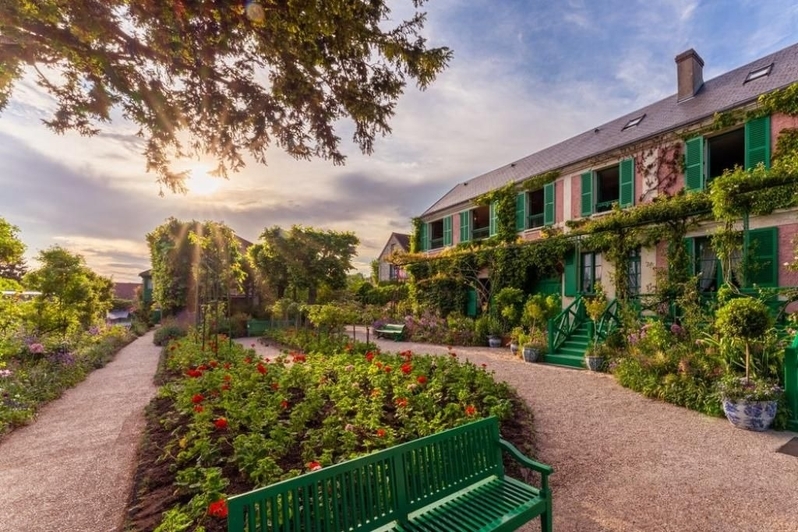
The architectural lesson of Giverny is not about monumental architecture. Monet's house is relatively modest. Its importance comes from how architecture interacts with landscape. The central idea could be described as: The house is not the destination of the garden. The house is part of the garden's composition. Monet's property developed over decades, and the house and gardens were progressively adapted to his lifestyle, gardening interests and artistic work.
The house as a visual anchor. The house at Giverny is a long, relatively low building with a distinctive exterior characterized by light-colored walls, green shutters and strong relationships with the surrounding planting. Rather than dominating the landscape with monumental architectural mass, it provides a relatively quiet backdrop against which the flowers become prominent. This is particularly important in the Clos Normand. You can think of the composition as: House → architectural background. Trees → vertical frame. Flower beds → foreground color. Path → movement and perspective. The architecture therefore establishes the scale and framework while the garden supplies much of the visual drama.
Architecture and landscape are deliberately blurred. One of the most interesting characteristics of Giverny is that the boundary between house and garden becomes relatively weak. The planting approaches the building. Climbing plants occupy structures. Windows look directly into gardens. Doors open toward the landscape. Paths connect interior and exterior. This creates something close to an indoor-outdoor living concept, although naturally it predates the modern architectural terminology. The garden isn't something viewed only from a distant terrace. It becomes an extension of domestic life.
Windows become landscape frames. This is especially important when considering Monet as a painter. A window is essentially a frame. For most houses: window → view. At Giverny: window → composition. Monet could look through a window and see: flowers, trees, changing light, sky, seasonal color and pathways. The architecture therefore creates controlled views into nature. This is remarkably similar to the way he framed subjects on a canvas. Architectural principle. A window should not merely provide light. It can be designed to frame a landscape. That is an idea still widely used in high-end residential architecture.
The dining room is an important architectural statement. The interior of Monet's house is particularly famous for its bright yellow dining room. This wasn't the restrained, neutral interior that we might associate with a traditional French country house. Monet used strong colors. The dining room's yellow walls are complemented by blue elements and Japanese prints. This demonstrates something important: Monet did not separate his color philosophy between painting, garden and interior. The same person who experimented with color outside also created a highly distinctive color environment inside.
Japanese art influenced the interior architecture. Monet was an important collector of Japanese ukiyo-e prints. His collection included works by artists such as: Hokusai. Hiroshige. Utamaro. These prints were displayed throughout the house. The influence is particularly interesting because it isn't simply about copying Japanese architecture. Instead, Monet incorporated Japanese visual culture into a French domestic environment. The result is a hybrid: French house. Japanese prints. Impressionist color. Normandy landscape. This combination makes Giverny visually distinctive.
The kitchen demonstrates functional architecture. The kitchen is another famous interior. It features blue-and-white ceramic tiles and a large traditional cooking range. Again, color is being used architecturally. The kitchen isn't simply functional. The blue-and-white palette gives the space a strong visual identity. It also contrasts with the yellow dining room. So Monet's interior design uses: Room → color → mood → identity, rather than trying to make the entire house visually uniform.
The house creates a transition sequence. A particularly useful architectural concept from Giverny is the sequence between inside and outside. Instead of: Interior → exterior, you can think of it as: Room à Door/window à Threshold à Path/terrace à Planting à Garden. This creates progressively stronger contact with nature. Modern architecture often calls this indoor-outdoor continuity. Giverny provides an early and very tangible example of the principle.
The architecture establishes human scale. The house is not enormous. This matters. The relatively modest scale allows the garden to remain the dominant experience. Imagine placing the same garden in front of a huge mansion. The visual relationship would change dramatically. At Giverny: human-scale house, large garden and garden feels immersive. The architecture effectively acts as a backdrop rather than competing with the landscape.
The Japanese bridge is landscape architecture. The famous bridge deserves to be considered architectural rather than merely decorative. The bridge performs several architectural functions simultaneously: Circulation - It allows people to cross the pond. Focal point - It establishes a recognizable visual center. Framing - It creates views toward the water and vegetation. Vertical form - Its arch contrasts with the horizontal pond. Reflection - Its shape appears again in the water. Experience - Crossing it changes the visitor's perspective. So the bridge isn't simply an object placed in a garden. It is an architectural instrument for experiencing the landscape.
Wisteria transforms architecture into vegetation. The bridge's relationship with wisteria is particularly beautiful. Instead of leaving the bridge as an isolated architectural object, climbing plants gradually integrate it into the landscape. This creates: Architecture → vegetation → landscape. The distinction becomes increasingly difficult to see. That is a very powerful contemporary design principle. Instead of: "Let's put some plants around the building." Think: "Let's allow vegetation to become part of the architecture."
Architecture as a frame rather than an object. This is perhaps the most important architectural lesson from Giverny. Traditional monumental architecture often says: Look at the building. Giverny often says: Look through, around and beyond the building. The house, bridge, paths, pergolas and openings help organize the visitor's view. This makes the architecture almost cinematic. You move through the property and continuously encounter different compositions.
The importance of thresholds. Giverny has many transitional conditions: interior → exterior, sun → shade, open → enclosed, geometric → organic, dry land → water, architecture → vegetation and straight path → curved landscape. These transitions prevent the experience from becoming monotonous. A well-designed garden isn't simply a collection of beautiful things. It is a sequence of changing spatial conditions.
Architecture and the Japanese concept of borrowed scenery. One useful concept when analyzing the Water Garden is shakkei, or borrowed scenery, associated with Japanese garden design. The basic idea is that a garden can visually incorporate elements beyond its immediate boundaries. Monet's garden doesn't exist as an isolated object. The visual experience incorporates: sky, surrounding vegetation, distant landscape, water and reflections. The pond effectively enlarges the garden because it reflects things that aren't physically inside it. This is another reason water is so important architecturally.
Reflection creates "virtual architecture". This is an especially fascinating way to think about the Water Garden. Suppose you have: Bridge. Trees. Sky. They physically occupy one side of the pond. But their reflections create a second visual world underneath. So the pond produces: physical landscape, reflected landscape = expanded landscape. In architectural terms, the water behaves almost like a second façade. It doubles the visual composition without physically doubling the space.
The garden changes the perception of the house. The architecture of Giverny cannot really be understood without the garden. Remove the garden and the house becomes a relatively ordinary historic residence. Put the garden back and the building becomes part of a much larger composition. That tells us something fundamental about landscape architecture: Architecture doesn't always need to be spectacular. A relatively simple building can become extraordinary through its relationship with: planting, water, views, paths, light and seasonal change.
A modern luxury-architecture interpretation. If we translate the Giverny principles into today's luxury residential architecture, we could develop something like this:
Principle 1 — Landscape first. Instead of designing the house and adding landscaping afterward, establish the major landscape composition early.
Principle 2 — Frame the view. Orient windows toward deliberately designed garden compositions.
Principle 3 — Make the garden part of daily life. Bedrooms, dining areas and living rooms should connect directly to landscape.
Principle 4 — Use water strategically. A pond or reflecting pool can visually expand a property.
Principle 5 — Create sequences. Don't reveal the entire landscape immediately.
Principle 6 — Integrate vegetation. Use pergolas, climbing plants and trees to soften architectural edges.
Principle 7 — Use color intentionally. Architecture and landscape can share a coordinated palette.
Principle 8 — Keep architecture subordinate when appropriate. A building doesn't always need to dominate the site.
The Giverny architectural formula. If I had to reduce the architecture and landscape of Monet's property to one diagram, I would describe it as: HOUSE à WINDOWS / DOORS à THRESHOLD à PATH / TERRACE à PLANTING à WATER à REFLECTION à SKY. And the visitor experiences all of these simultaneously. That is why Giverny is more useful as an architectural case study than simply as a historic artist's home. It demonstrates an early form of what contemporary luxury architecture increasingly tries to achieve: Architecture that doesn't merely sit in nature, but makes the experience of nature part of the architecture itself.
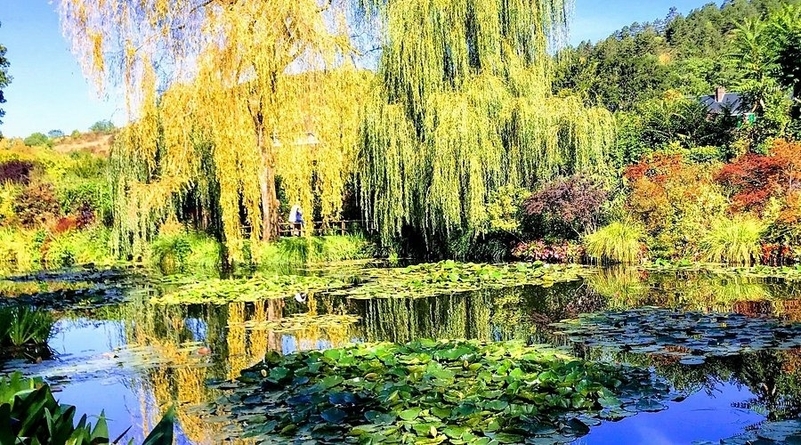
What makes Giverny especially fascinating is that Monet wasn't simply interested in having attractive plants. He developed a horticultural strategy around color, flowering sequence, plant height, texture, seasonal change, species selection and maintenance. The present garden continues to interpret that horticultural vision.
Monet was a serious gardener, not simply an artist with a garden. This distinction is important. Monet moved to Giverny in 1883 and spent the next four decades transforming the property. The official Fondation Monet describes him as both passionate about botany and an inventive gardener who arranged his garden like an artwork. His horticultural interests became increasingly sophisticated. He: searched for unusual plants, purchased plants from nurseries, exchanged plants with friends, experimented with combinations, observed flowering periods, considered color relationships, managed plant heights, used climbing plants architecturally, cultivated water lilies and continually modified the garden. A contemporary account of the garden notes that Monet exchanged plants with figures including Georges Clemenceau and Gustave Caillebotte, while seeking rare varieties. This makes Giverny a useful example of artist-led horticulture.
The horticultural system has two very different environments. The first principle is that Monet didn't use one planting strategy throughout the property.
Clos Normand. The flower garden is essentially a high-intensity horticultural composition. It emphasizes: flowering plants, annuals, bulbs, roses, climbing plants, color, succession, density and height variation.
Water Garden. The Water Garden is more of a woody-plant and aquatic planting system. It emphasizes: water lilies, willows, bamboo, Japanese maples, ginkgo, wisteria, rhododendrons, azaleas, ferns and tree peonies. The current plant list illustrates how dramatically the two environments differ. So Giverny is not one garden horticulturally. It is almost two different botanical worlds connected by the Monet aesthetic.
The Clos Normand was transformed from orchard to flower garden. When Monet arrived, the approximately one-hectare area contained an apple orchard and kitchen garden. It also had a central path lined with conifers and flower beds edged with clipped boxwood. Monet progressively dismantled much of this existing horticultural structure. He removed the boxwood. He had spruce trees cut down. He replaced the trees with metal arches. Apple trees were replaced with Japanese cherry and apricot trees. Then he introduced large quantities of flowering plants including: daffodils, tulips, narcissi, irises, Oriental poppies, peonies, roses, nasturtiums, hollyhocks and annual flowers. This is important because Monet didn't merely decorate the existing garden. He fundamentally changed its horticultural identity.
The "planting palette" was carefully constructed. Monet approached plants almost like an artist approaches pigments. The official garden description says he created rectangular beds of single colors, comparing them directly to colors on a painter's palette. This gives us a useful horticultural concept: Plants were selected for their visual relationships. For example:
Yellow → yellow iris → yellow tulips → yellow flowers
versus:
Blue / violet → iris → delphinium → other cool-toned flowers
versus:
Red / orange → poppies → nasturtiums → warm-toned flowers
The goal wasn't necessarily botanical uniformity. It was chromatic harmony and contrast.
Monet used plant height as a horticultural tool. Giverny doesn't consist of one level of flowers. There is a deliberate vertical hierarchy. Low layer: bulbs, pansies, violas and small annuals. Middle layer: iris, peonies, roses, dahlias and other flowering plants. Tall layer: hollyhocks, delphinium, cleome, trees and climbing plants. The garden's plantings use groups of different heights to create volume, with trees rising above roses, hollyhocks and annuals. This is horticulture functioning as three-dimensional composition.
Climbing plants are crucial. One of the signatures of Giverny is the use of climbers. The central alley has iron arches supporting climbing roses. Roses also grow along the house balustrade. Later in the season, nasturtiums spread dramatically through the central path. In the Water Garden, wisteria becomes particularly important. It covers the Japanese bridge with cascading flowers, turning a rigid architectural structure into a living element. This demonstrates an important horticultural principle: A climbing plant can function as both a plant and an architectural material.
Roses provide structure and fragrance. Roses aren't simply scattered around Giverny. They are integrated into the architecture and circulation system. The central path is associated with fragrant roses and nasturtiums, while climbing roses occupy the arches and roses line the house. This means roses contribute at least four things: Color - Visual identity. Height - Vertical structure. Fragrance - A sensory dimension. Architecture - They transform arches and edges. So horticulture at Giverny isn't purely visual. It is multi-sensory.
Nasturtiums are deliberately allowed to become exuberant. The nasturtium is one of the most interesting examples. Rather than keeping it perfectly controlled, Monet allowed it to spread dramatically through the central alley. The current garden's description notes that Lobb's nasturtiums eventually climb along the central path and dramatically transform the main view. This is almost the opposite of a highly formal European garden. Instead of: plant → boundary → clipping → control. Monet often pursued: plant → growth → movement → visual abundance. That creates the impression of spontaneity even though the underlying horticultural system requires considerable management.
"Natural" does not mean unmanaged. This is an important misconception about Giverny. The garden may look spontaneous, but it requires enormous horticultural intervention. The historical and current horticultural descriptions show extensive maintenance, including: staking tall plants, monitoring annuals, pruning climbers, managing water lilies, controlling pests, dividing irises, maintaining beds and removing dead foliage. For example, the institutional documentation notes that tall plants such as hollyhocks and delphinium require staking, while annuals must be monitored so they don't overwhelm the garden. So the aesthetic is: controlled naturalism. It looks natural. It isn't natural.
Seasonal succession is fundamental. One of the most sophisticated aspects of Giverny's horticulture is succession planting. The garden is designed so that something is always changing. The current garden contains more than 100 varieties that bloom successively from spring into autumn. A simplified sequence looks like: Early spring, snowdrops, crocuses, daffodils, tulips and early irises. Late spring: wisteria, irises, peonies and roses. Summer: poppies, hollyhocks, delphinium, cleome and roses. Late summer / autumn: dahlias, nasturtiums, asters and later flowering plants. The exact modern planting program changes, but the principle remains. The garden is designed as a calendar.
Water lilies are horticulturally demanding. The Water Garden is perhaps the greatest example of Monet's horticultural ambition. Monet created the pond by diverting a branch of the River Epte in 1893. He later enlarged the pond, and water lilies became one of the garden's defining elements. Today the pond contains around 70 varieties of water lilies, according to the current Fondation guide. They generally bloom from late June through September, with peak flowering in July and August. The horticultural requirements are surprisingly specific. The official Giverny guidance notes that water lilies: are planted approximately 30–50 cm below the water, need sunlight, dislike strong currents, generally prefer water above approximately 16°C for flowering and retreat beneath the water during winter. So the famous "effortless" water-lily landscape is actually a highly managed aquatic garden.
Monet's water lilies required dedicated maintenance. The official Giverny description states that the water lilies were extremely high-maintenance and that several gardeners were assigned daily work related to them. Another official account says that one gardener was dedicated full-time to the Water Garden and removed dead leaves to maintain its appearance. This tells us something fascinating: The appearance of natural purity required intensive human intervention. That is one of the recurring paradoxes of Giverny.
The Water Garden uses an Asian horticultural vocabulary. Monet's plant selection deliberately created an Asian-inspired atmosphere. Important plants include: bamboo, black bamboo, Japanese maple, ginkgo, Japanese tree peonies, Japanese cherry, Japanese quince, wisteria, weeping willow and water lilies. The combination of these plants with the bridge and pond creates the Water Garden's distinctive character. But it is better understood as Monet's interpretation of Japanese aesthetics rather than a strict reproduction of a traditional Japanese garden.
Trees are used as permanent structure. Flowers change. Trees provide continuity. The Water Garden uses: weeping willow → soft, cascading silhouette, bamboo → vertical rhythm, ginkgo → distinctive foliage and seasonal change, Japanese maple → delicate foliage and color, alder / ash / poplar → larger structural canopy. The current plant list documents this combination of woody plants around the pond. This creates a horticultural hierarchy: Trees = permanent framework. Shrubs = intermediate structure. Perennials = seasonal structure. Annuals = changing color. Water lilies = floating seasonal composition
The horticultural strategy is essentially "permanent + temporary" This is one of the best ways to understand Giverny. Permanent layer: Trees. Shrubs. Pond. Bridge. Major climbing structures. Seasonal layer: Roses. Irises. Peonies. Hollyhocks. Dahlias. Temporary layer. Annual flowers. Nasturtiums. Short-lived flowering displays. The combination ensures that the garden never completely loses its identity while constantly changing.
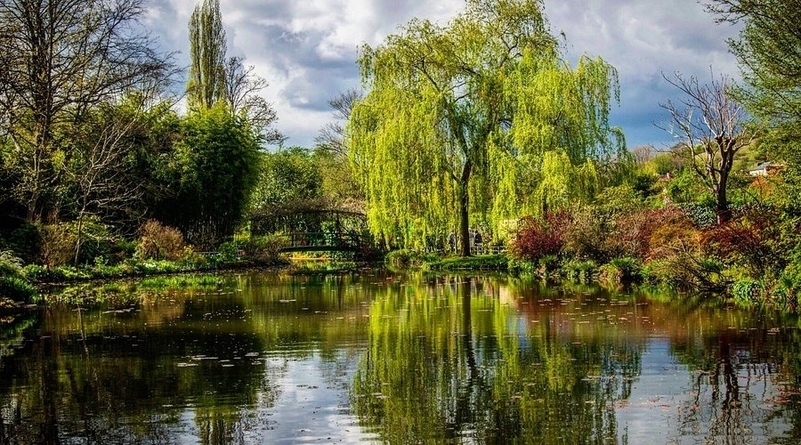
Botanical diversity was important to Monet. Monet wasn't satisfied with ordinary plants. Historical accounts describe him as continually searching for rare varieties and spending significant amounts on plants. This is essentially a collector's mentality combined with an artist's eye. But instead of displaying plants like a botanical museum, Monet integrated them into visual compositions. That distinction is important. Botanical garden. "Here is the plant." Monet's garden. "Here is what this plant does when combined with these plants, this light and this space."
Horticulture becomes painting in three dimensions. This is ultimately Monet's most interesting contribution. A painter controls: hue, saturation, contrast, scale, composition, repetition and light. Monet translated these into horticulture: Painting à Horticulture. Color à Flower selection. Brushstroke à Plant grouping. Composition à Flower-bed arrangement. Perspective à Plant height. Texture à Foliage. Light à Garden orientation. Movement à Seasonal change. Reflection à Water. Frame à Trees / architecture. Layering à Plant heights. This is why the official Fondation describes the garden as an "outdoor palette."
The most sophisticated principle: succession rather than perfection. A conventional ornamental garden might aim to look "finished." Giverny is different. Its beauty comes from change. A tulip disappears. An iris takes over. Then the roses dominate. Then the hollyhocks rise. Then nasturtiums spread. Then dahlias and autumn flowers become important. The garden therefore behaves almost like a living painting that is constantly being repainted.
The horticultural philosophy of Giverny. If we reduce everything to a few principles, Monet's horticultural philosophy could be summarized as: Plant for color - Not simply for species. Plant for succession - Think about what happens next month. Plant vertically - Use height to create depth. Plant for texture - Leaves matter as much as flowers. Plant for movement - Climbers and spreading plants can transform space. Plant for the senses - Color, fragrance, sound and reflection all matter. Combine control and freedom - Give plants a framework, but allow exuberance. Use rare plants selectively - Botanical interest can coexist with visual composition. Treat water as a habitat and visual surface - Not simply as decoration. Maintain aggressively behind the scenes. The appearance of natural abundance requires professional horticultural care.
The biggest lesson from Giverny. Perhaps the most important horticultural lesson is this: Monet did not try to make nature look artificial. He tried to make carefully managed nature look abundantly alive. That is why Giverny feels so different from a rigid formal garden. There is structure, but you don't always see it. There is maintenance, but you don't feel it. There is horticultural planning, but the final impression is spontaneity. And that balance—structure underneath, exuberance above—is arguably one of the most enduring ideas that can be taken from Monet's garden.
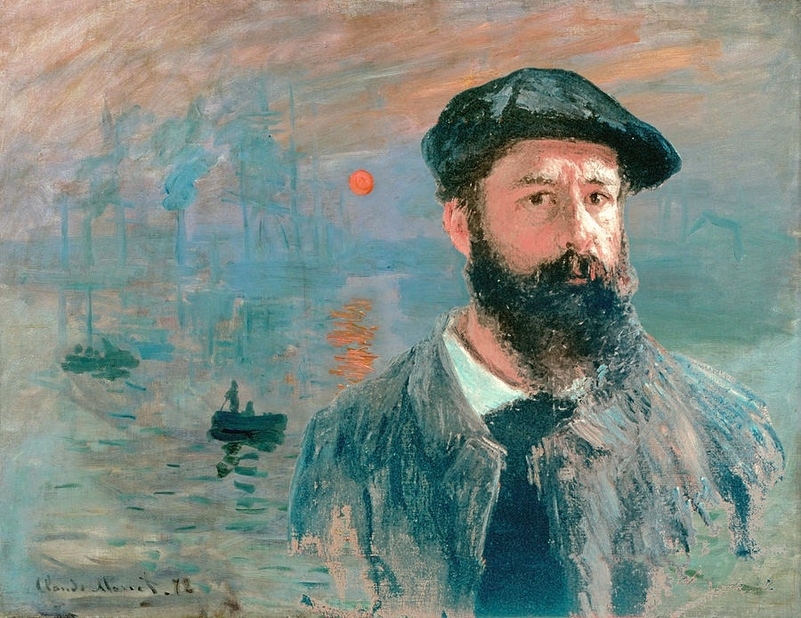
He wasn't simply a painter who happened to live at Giverny; he gradually created a way of life in which painting, gardening, collecting, food, family, friends, travel, Japanese art and the changing seasons all fed into one another. The most interesting way to understand Monet is therefore not just as "the painter of water lilies," but as someone who designed his everyday environment around his artistic vision.
Monet's fundamental lifestyle — living through observation. Monet's art was built around something deceptively simple: Look → observe → experience → paint → observe again. He was fascinated by the way the same subject could look completely different depending on: time of day, season, weather, sunlight, fog, reflections and atmospheric conditions. The National Gallery of Art describes his work as an effort to capture changing effects of light and atmosphere, particularly through painting outdoors. This explains why his lifestyle gradually became increasingly connected to particular places. Instead of constantly searching for new subjects, Monet increasingly created environments where he could observe change repeatedly. Giverny became the ultimate expression of this.
Giverny became his personal world. Monet moved to Giverny on 29 April 1883 and remained there until his death in 1926. The property became much more than a residence. It became: Home. Garden. Studio. Laboratory. Social space. Artistic subject. Collection. Retreat. This is why studying Giverny tells us so much about Monet's lifestyle. He wasn't simply painting the world around him. He increasingly constructed the world he wanted to observe. The National Gallery of Art describes the garden as both a source of inspiration and a living work of art.
Monet the gardener. This is probably the most important part of his lifestyle after painting. Monet became a serious horticulturalist. He read gardening publications, exchanged seeds, collected gardening books and eventually employed a team of gardeners. He gave detailed instructions about planting and pruning and inspected the garden regularly. That tells us something important about his personality as an artist: He wasn't waiting for inspiration. He was actively creating the conditions for inspiration. He could decide: which flowers to plant, where they should grow, what colors should be next to each other, when they should bloom, how tall they should become, how they should frame a path and how vegetation should surround the pond. The garden became an artistic instrument.
The garden was also his outdoor studio. Monet's relationship with Giverny was unusual because the subject and the studio were effectively the same place.The garden gave him an enormous range of subjects: Flowers → color. Trees → structure. Water → reflection. Sky → atmosphere. Bridge → architecture. Changing seasons → time. The National Gallery notes that Monet eventually produced more than 250 paintings focused on water lilies. That's extraordinary repetition. But for Monet, repetition wasn't necessarily redundancy. The question was: How many different paintings can exist within the same subject?
Monet's obsession with changing light. This is fundamental to his artistic lifestyle. He wasn't primarily interested in describing an object permanently. He was interested in what the object looked like at a particular moment. A haystack at 8:00 a.m. wasn't the same subject as the same haystack at sunset. A cathedral façade in morning light wasn't visually identical to the same façade in evening light. A water lily pond under clouds wasn't the same image when sunlight broke through. This led to his famous series paintings. He painted: Haystacks. Poplars. Rouen Cathedral. London. Venice. Water lilies. The National Gallery describes his series as studies of specific atmospheric effects and times of day.
His lifestyle became increasingly "place-based". Early Monet traveled extensively in search of landscapes. Later Monet increasingly had the landscape come to him. This is a major transition. Earlier Monet: Travel → find subject → paint. Giverny Monet: Create environment → observe → paint. The Water Garden is the ultimate example. He acquired land in 1893, diverted a small branch of the River Epte and created the pond himself. The landscape that later appeared in The Japanese Footbridge was therefore largely designed by Monet himself. This is a remarkable artistic situation: Artist à creates landscape à observes landscape à paints landscape. The garden becomes both art object and art subject.
Japanese art became part of his lifestyle. Monet's interest in Japan was not a passing fashion. He became a major collector of Japanese woodblock prints. The Fondation Monet records a collection of 211 prints, including works by: Kitagawa Utamaro. Katsushika Hokusai. Utagawa Hiroshige. The collection included 46 prints by Utamaro, 23 by Hokusai and 48 by Hiroshige among the works on display. He didn't simply keep them in storage. He lived among them. Japanese prints decorated the walls of his home at Giverny. This means Japanese art became part of his domestic environment, not merely his artistic reference library.
He brought Japan into Normandy. This is where lifestyle, architecture, horticulture and art converge. Monet never needed to travel to Japan to create his own interpretation of Japanese aesthetics. At Giverny he introduced: Japanese prints, bamboo, Japanese maples, Japanese tree peonies, ginkgo, wisteria, Japanese-style bridge and water garden. The Fondation Monet specifically describes his passion for Japan as influencing both his home and garden. The result wasn't a Japanese garden in the strict traditional sense. It was Monet's personal interpretation of Japan.
His home was an extension of his art. The interior of the house is extremely revealing. The dining room was decorated with yellow walls and yellow furniture, with Japanese prints covering the walls. The kitchen used distinctive blue Rouen tiles, blue-and-white ceramics and copper utensils. This tells us that Monet's obsession with color extended beyond canvas. His environment itself became a composition. Think of it as: Painting - Color relationships. Garden - Color relationships. Interior - Color relationships. Clothing / objects / ceramics - Color relationships. He was effectively living inside a palette.
The house was also a social environment. Giverny was not an isolated hermitage. The house was busy. The Fondation Monet describes a household containing eight children, activity between the studio and garden, food arriving from the kitchen garden, trips to the market and friends visiting from Paris. So the romantic image of Monet as a solitary painter beside a pond is incomplete. His later life involved: family, domestic staff, gardeners, artists, collectors, visitors, friends and Japanese art dealers and collectors. Giverny became a social and cultural environment.
Monet and his artistic circle. His house also reflected his relationships with other artists. The Fondation Monet notes that works by artists including: Eugène Boudin. Johan Jongkind. Édouard Manet. Pierre-Auguste Renoir. Berthe Morisot.Gustave Caillebotte. Camille Pissarro. Alfred Sisley. Edgar Degas. Paul Cézanne. Paul Signac, were part of the group of works associated with his private living spaces. This gives us another dimension of his lifestyle. His home wasn't simply decorated with expensive art. It was surrounded by the artistic community to which he belonged.
Food and the garden. The garden wasn't purely ornamental. The Giverny household also had a kitchen garden and food was part of the rhythm of domestic life. The Fondation describes vegetables arriving fresh from the kitchen garden and activity around the kitchen and market. This gives us a more complete picture: Garden → flowers → vegetables → fruit → water → landscape → inspiration. The garden therefore served both aesthetic and practical purposes.
Monet's lifestyle was highly sensory. This is an interesting way to reinterpret his life. His environment involved: Sight - Color, flowers, paintings, water and changing light. Smell - Roses, wisteria, flowers, vegetation and food. Sound - Water, insects, birds and garden activity. Taste - Vegetables, fruit and meals prepared at home. Touch - Plants, gardening and physical interaction with the landscape. His artistic philosophy was therefore not purely intellectual. It was profoundly sensory.
The pond became an obsession. The Water Garden eventually became the center of Monet's artistic world. The National Gallery of Art notes that in his final decade he painted little else besides the lily pond. He called these works paysages d'eau, or "waterscapes." The pond became fascinating because it was never visually stable. It contained: water, sky, clouds, trees, flowers, reflections and light. Everything was constantly changing. So Monet could remain in essentially the same place and still experience endless visual variation.
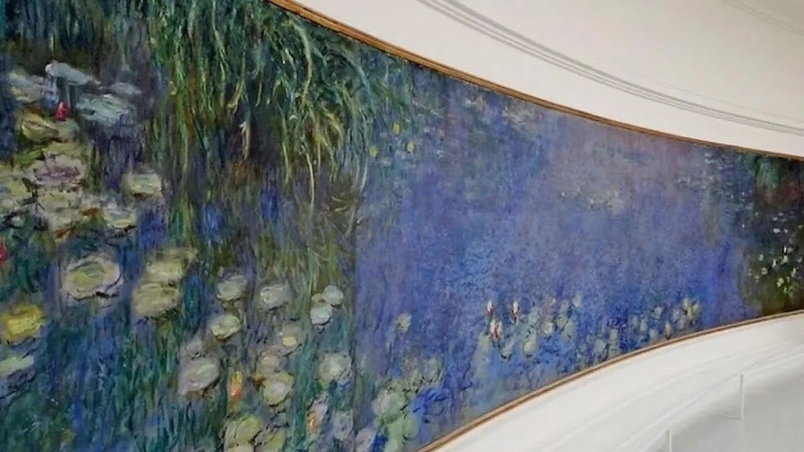
He designed the pond specifically for observation. This is one of the most extraordinary aspects of his lifestyle. Monet was not simply attracted to water. He designed the water garden around his artistic interests. The pond was shaped. Plants were selected. The bridge was constructed. Water lilies were cultivated. The surrounding vegetation was managed. And the water was maintained to preserve its reflective quality. The National Gallery's educational material notes that Monet insisted his gardeners keep the pond extremely clean so that reflections of sky, clouds, trees and shrubs would appear clearly. In other words: He was managing the optical conditions of his art.
Monet's lifestyle was about repetition. Modern culture often associates creativity with novelty. Monet demonstrates another model: Creativity can come from observing the same thing more deeply. He could paint the same pond repeatedly because every day offered a different combination of: light, weather, season, reflection, color, time and atmosphere. This is one reason the Giverny lifestyle feels surprisingly modern. It values attention over distraction.
His lifestyle was also highly curated. There is an important contradiction here. Monet's paintings often appear spontaneous. His lifestyle at Giverny was anything but accidental. He deliberately curated: The garden. The house. The art collection. The Japanese prints. The water. The plants. The views. The studio. The social environment. So behind the apparent spontaneity of Impressionism was a considerable amount of planning and cultivation.
Art and lifestyle eventually became one system. You can visualize Monet's world like this: PAINTING à inspires. GARDEN à provides. SUBJECTS à require. HORTICULTURE à shapes. LANDSCAPE à frames. ARCHITECTURE à connects to. HOME à contains. JAPANESE ART à influences. GARDEN DESIGN à produces. NEW PAINTINGS. And the cycle repeats. That's what makes Monet's lifestyle so fascinating. It was essentially a creative ecosystem.
Monet's version of luxury. From a modern perspective, there is another interesting interpretation. Monet eventually achieved something that could be described as a highly personalized form of luxury: Not necessarily luxury through expensive objects, but: Luxury through control of environment. He could determine: what he saw, what he planted, what colors surrounded him, what art hung on his walls, where he painted, how his garden changed, who he entertained and how his home connected to nature, In that sense, Giverny became a prototype for an idea that is very relevant to contemporary luxury living: The ultimate luxury is designing your environment around the way you want to live.
Monet as an early "lifestyle designer". This is where I think Monet becomes particularly relevant to a modern Living / Arts & Culture audience. He effectively designed an integrated lifestyle around five things: Art - His professional and intellectual world. Nature - His primary source of visual inspiration. Home - A place designed around family, art and gardening. Collecting - Japanese prints and works by fellow artists. Time - Living according to seasons, flowering cycles and changing light. Rather than separating these areas, he combined them.
Monet's lifestyle philosophy in one diagram: OBSERVE => CREATE => CULTIVATE => LIVE => OBSERVE AGAIN
That is perhaps the best way to understand Giverny. Monet didn't merely paint his lifestyle. He gradually turned his lifestyle into part of his art. And that is why the story of Monet becomes much more interesting when you move beyond Water Lilies and look at the house, garden, horticulture, Japanese collection, food, family, friendships and daily routines as one integrated creative environment.